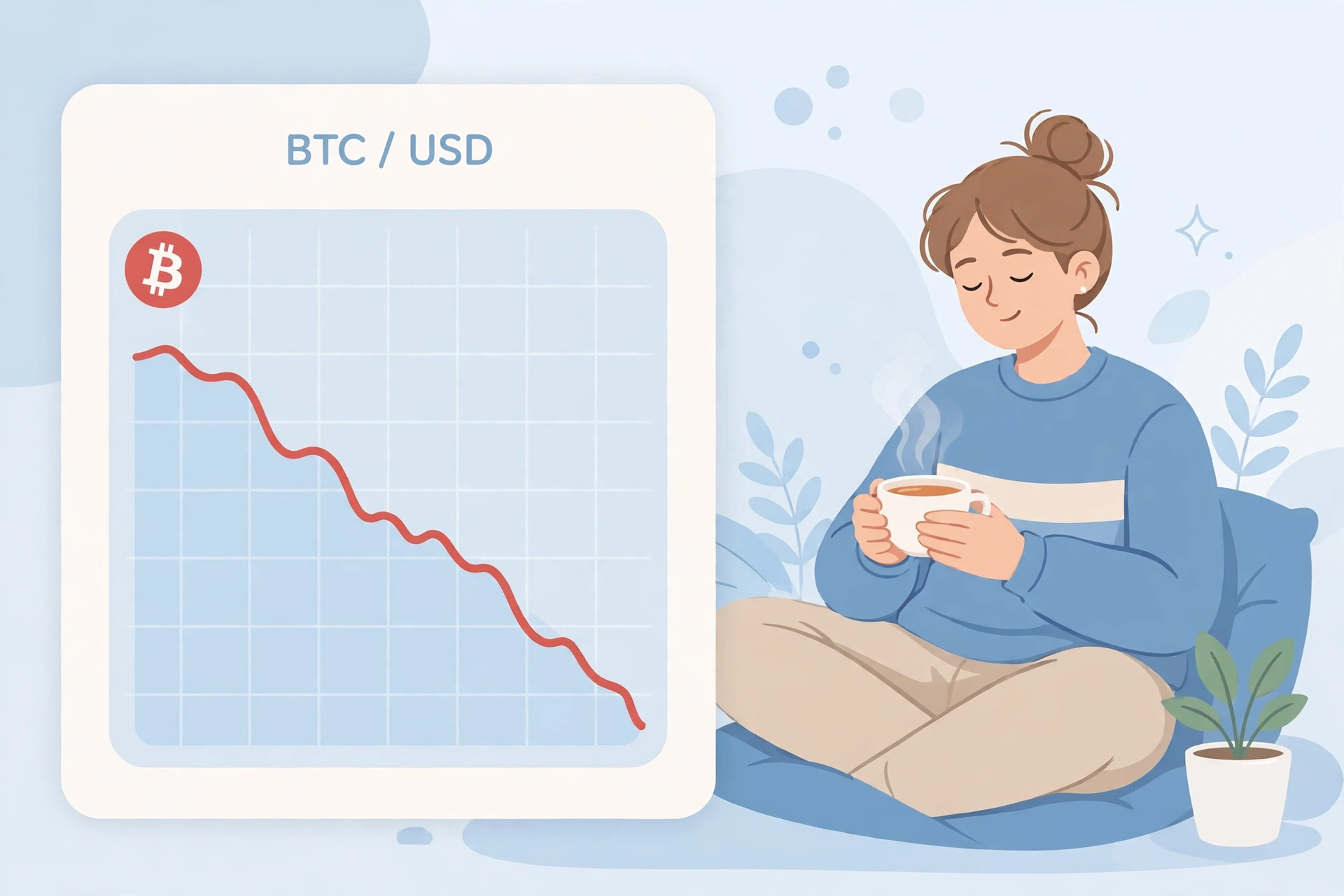
Hey. Take a breath. Seriously — breathe in, breathe out. If you opened your crypto app this month and your heart dropped, you are not alone. Millions of people felt the exact same thing. And guess what? That feeling is normal. It does not mean you did something stupid. It means you are human, and you own something that moves fast.
This article is not going to tell you to buy, sell, or hold. Nobody honest can tell you that. What it will do is walk you through what actually happened, why your brain is playing tricks on you right now, and how to make a calm plan instead of a panicked one. Deal?
What Just Happened — The Facts, No Drama
Let’s keep this simple. In November 2026, Bitcoin fell hard. It dropped to around $55,000 on 21 November — its lowest price since September 2024. That is roughly half of what it was at its highest point, about $126,000 in October 2025. It fell for seven weeks in a row.
Bitcoin was not the only one. Ethereum dropped to around $1,600–$1,700, and Solana fell to around $70. The whole crypto market went down together.
Big investors pulled money out too. US spot Bitcoin ETFs — those are the funds that let regular investors buy Bitcoin through the stock market — lost around $3 billion in November alone.
And the mood? The Crypto Fear & Greed Index, which measures how scared or greedy the market feels, read 11–12 out of 100. That is labelled “Extreme Fear”. In plain words: almost everyone is scared right now.
Why Did It Fall? (In Plain Words)
There is no single villain here. A few things piled up at once:
Big investors got nervous. When stock markets wobble, big funds often sell risky stuff first — and crypto counts as risky stuff to them. Money flowed out of the Bitcoin ETFs, and that pushed prices down.
The Fed kept everyone guessing. The US Federal Reserve decides interest rates, and markets hang on every hint about what it will do next. When the outlook feels unsure, prices of risky things tend to fall. Crypto is not the only market that felt it — stocks dipped too.
The Binance hack shook trust. At the end of October 2026, Binance — the world’s biggest crypto exchange — lost around $6.34 billion in a hack, the largest crypto theft ever. That scared a lot of people, and scammers jumped on the chaos (more on that below).
Then it fed on itself. When prices fall, some people sell because they are scared. That pushes prices down more. Then more people sell. It is a loop, and it happens in every market, not just crypto.
Did you know? People searched “Is Bitcoin going to zero?” and “Bitcoin dead” more in late 2026 than at any time since the FTX collapse in 2022. And yet, Bitcoin has been called “dead” hundreds of times since 2010 — and it is still here. A crash is not the same thing as a death.
The Three Feelings Every Beginner Gets — And Why They Trick You
Here is the part nobody tells you. Your feelings during a crash are not random. They follow a pattern, and knowing the pattern helps you beat it.
1. Panic — “I need to sell RIGHT NOW.” Your brain treats a falling number like a fire alarm. It screams “get out!” But selling in a panic usually means selling at the worst moment — after the fall has already happened. Ask yourself: would you sell your house the day house prices dip? Probably not.
2. Regret — “Why did I ever buy this?” Hindsight is a liar. When prices are up, buying feels smart. When prices are down, the same buy feels dumb. Nothing about the buy changed — only the price did. Be kind to past-you. Past-you made the best call they could with what they knew.
3. The urge to “win it back” — “I’ll just put in more and make it back fast.” This is the sneakiest one. It feels like fixing the problem. But throwing more money in — especially money you cannot afford to lose, or borrowed money — to chase a loss is how small losses turn into big ones. If you catch yourself thinking this, that is your sign to stop and step away from the app for a day.
The Calm Plan: Four Steps
Okay, deep breath. Here is a simple plan. No rush. Do it in order.
Step 1: Pause. Close the app. Seriously. Put the phone down for a few hours. Prices move every second, but your life does not need a live feed of it. You will think clearer after a break. The market will still be there tomorrow.
Step 2: Check your own position, not the headlines. Ask yourself three honest questions: How much did I put in? Can I afford to lose it and still pay my bills? Was this money I planned to keep invested for years, or money I need next month? Your answers matter way more than what any YouTuber says. If the money you invested was money you could afford to lose, your situation has not changed — only the price has.
Step 3: Do not borrow money to “win it back.” This one is a hard rule. Never take a loan, never use a credit card, never dip into rent money to buy more crypto in a crash. If you cannot afford it, the answer is no. Full stop.
Step 4: Decide what kind of investor you are — then stick to it. Some people buy and hold for years and ignore the noise. Some people only put in a small fixed amount each month (that is called DCA — keep reading). Some people decide crypto is not for them and step away. All three are fine. What is not fine is switching plans every time the price moves. Pick a plan when you are calm, and follow it.
What Is DCA? (The Boring Trick That Actually Works)
DCA stands for dollar-cost averaging. Fancy name, simple idea: instead of buying a big chunk all at once, you buy a small fixed amount on a regular schedule — say $50 every month — no matter what the price is.
When the price is high, your $50 buys less Bitcoin. When the price is low, your $50 buys more. Over time, it averages out. You stop trying to guess the perfect moment to buy (spoiler: nobody can), and you stop making emotional decisions in a crash.
This is not a magic money machine, and it is not a promise you will profit. It is just a calmer way to buy — one that takes the panic out of the decision. If you want to learn how buying works in the first place, start with our step-by-step guide.
Also read: How to Buy Your First Bitcoin — the plain-English guide to buying safely.
Scams Love a Crash — The Fake “Recovery” Messages to Ignore
Here is the ugly truth: when people are scared, scammers get busy. After the Binance hack in October 2026, crypto impersonation scams jumped nearly 129% in just a few days. Fake “support” messages, fake “recovery” offers, fake giveaways — they all target people who are worried about their money.
So if you get any of these, delete and ignore:
- A text or email saying your exchange account had a “suspicious login” and asking you to click a link.
- Someone offering to “recover” your lost crypto for a fee.
- A message saying you can “double your Bitcoin” if you send some first.
- Anyone — and we mean anyone — asking for your seed phrase or private key. Real support will never ask for it. Ever.
If you want to test your scam-spotting skills, try our quiz — it is actually fun, and one right answer could save you real money.
Also read: Crypto Scams: How to Spot Them Before They Get You — the full guide to the tricks scammers use.
What a Crash Can’t Tell You
A crash tells you what the price did. It does not tell you what the price will do next. Nobody knows that — not the experts on TV, not the people shouting on social media, and definitely not the random account promising Bitcoin will hit some magic number next year. Anyone who says they know the future price is either guessing or selling you something.
If you are feeling stuck, or the money involved is big enough to stress you out, talk to a qualified financial adviser — a real one, in person, who understands your situation. A blog post (yes, even this one) is not a substitute for that.
And remember: you are early in your crypto journey, and crashes are part of it. Every person who has held Bitcoin for years has lived through drops like this. The question is never “will it crash again?” — it will. The question is: do you have a calm plan for when it does? Now you do.
Disclaimer: This article is general information for learning only — it is not financial advice, and it is not telling you to buy, sell, or hold anything. Crypto prices can fall a lot, and you can lose money. Only ever use money you can afford to lose, and talk to a qualified financial adviser before making big money decisions.
Also read: Best Crypto Wallets for Beginners — where to keep your crypto safe, whatever the market is doing.