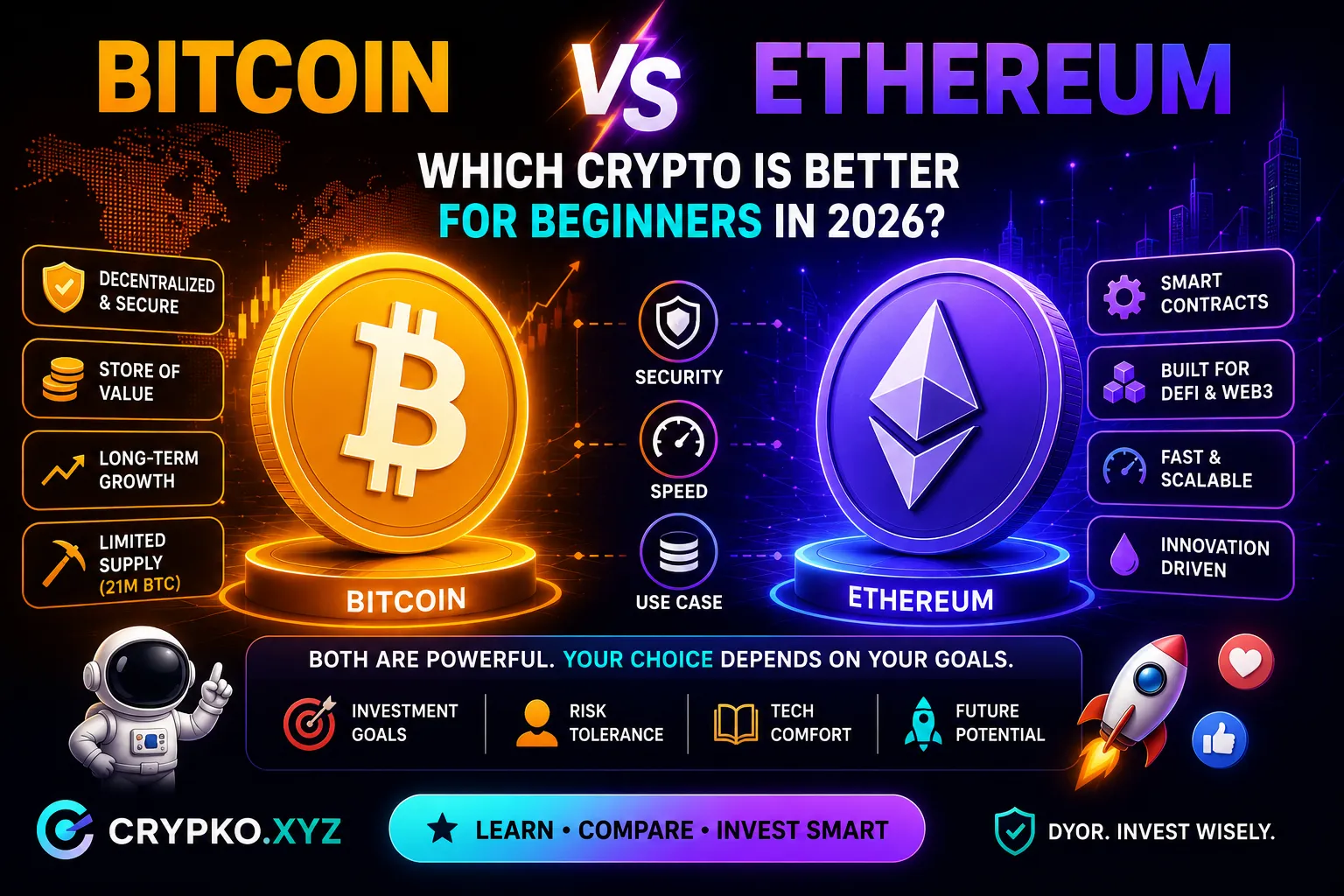
Bitcoin vs Ethereum: Which Crypto Is Better for Beginners in 2026?
My cousin called me last month with a question I’ve now heard at least fifty times from different people.
“I want to buy my first crypto. Should I get Bitcoin or Ethereum?”
What followed was a 40-minute conversation that covered everything from how wallets work to why Ethereum gas fees exist to whether now is even a good time to buy anything. By the end of it, he had enough to make his own decision — and he chose differently from what I expected him to.
If you’re at that exact same starting point — you know you want to enter crypto, you’ve narrowed it down to the two biggest names, and you’re not sure which one fits your situation better — this is the conversation I’d have with you.
No hype. No price predictions. Just a clear breakdown of what each one actually is, how they behave differently, and how to think about which one makes sense for where you are right now.
First — Why These Two Specifically?
There are thousands of cryptocurrencies. The reason Bitcoin and Ethereum come up for beginners isn’t arbitrary.
Both have survived multiple full market cycles — the crashes of 2018, 2022, and the various corrections in between. Both are listed on every major regulated exchange in the world. Both have been held by enough people, for long enough, that they have established track records you can actually study.
Everything else in crypto is more speculative than these two. That doesn’t make everything else worthless — some of those projects are genuinely interesting. But for a first purchase, starting with assets that have survived the longest and have the deepest liquidity is just sensible.
The question is which of the two — and the answer isn’t the same for every person.
What Bitcoin Actually Is
Bitcoin is the original. It launched in 2009, and for its entire existence it has done essentially one thing: function as a decentralized, scarce, digital store of value.
There are only ever going to be 21 million Bitcoin. That number is hardcoded into the protocol and cannot be changed. No company controls it. No government can print more of it. The supply is fixed, the issuance schedule is predictable, and the network has run continuously for over 15 years without being hacked or shut down.
That’s a remarkable track record for any technology, let alone financial technology.
The way I explain Bitcoin to people who’ve never held any: imagine gold, but you can send it to anyone in the world in ten minutes, you can hold any fraction of it, and you don’t need a vault to store it — just a password.
That’s obviously simplified, but it captures the core idea. Bitcoin is a bet on the idea that people will increasingly value a form of money that no institution can debase or control.
What Bitcoin is not: It’s not a platform for building applications. You can’t run DeFi protocols on Bitcoin. You can’t issue tokens on it easily. You can’t use it to pay gas fees for smart contracts. It’s designed to do one thing exceptionally well — be a reliable, immutable store of value — and that intentional simplicity is part of its appeal.
What Ethereum Actually Is
Ethereum is fundamentally different in purpose, even though it’s often lumped together with Bitcoin as “the big two.”
Where Bitcoin is a savings technology, Ethereum is a computing platform. It’s a blockchain that runs code — smart contracts — which means you can build almost any financial application on top of it. DeFi lending protocols, decentralized exchanges, stablecoins, NFT marketplaces, tokenized real-world assets — almost all of it runs on Ethereum or networks built on top of Ethereum.
When I first started using DeFi seriously, I was using Ethereum constantly. Every interaction with Aave, Uniswap, or any lending protocol required sending transactions on Ethereum. The network is genuinely central to the crypto ecosystem in a way that goes beyond price.
The ETH token has multiple roles: it’s used to pay for transactions on the network (gas fees), it can be staked to earn yield, and it’s the reserve currency that denominator most of DeFi. Holding ETH is a bet on the idea that this computing platform will continue to be the foundational layer for decentralized finance and applications.
After Ethereum’s transition to Proof of Stake (called “The Merge”), ETH also became a yield-generating asset — holders who stake their ETH earn approximately 3–4% annually just for participating in network validation. Bitcoin holders earn nothing from simply holding.
The Key Differences — Side by Side
Let me go through the things that actually matter for a beginner making a first purchase:
Simplicity of the thesis
Bitcoin is easier to understand. “Fixed supply, decentralized, digital gold.” Full stop. You don’t need to understand smart contracts, DeFi, Layer 2 networks, or gas fees to have a reason to own Bitcoin.
Ethereum’s value proposition is more complex. To really understand why ETH has value, you need to understand that it’s the native currency of a computing platform — and that the platform’s usage drives demand for the token. That’s not impossible for a beginner, but it requires more conceptual scaffolding.
Winner for simplicity: Bitcoin.
Volatility
Both are volatile. Significantly more volatile than stocks, real estate, or any traditional asset class. But historically, Ethereum has been more volatile than Bitcoin — larger percentage gains in bull markets, larger percentage drops in bear markets.
This cuts both ways. More volatility means more potential upside AND more potential downside. For a beginner who might panic-sell during a sharp drop, higher volatility is a real risk factor.
Winner for stability: Bitcoin (relative to Ethereum, though neither is stable).
Yield and utility while holding
If you stake ETH — either directly through a validator or via liquid staking protocols like Lido or Rocket Pool — you earn staking rewards. Currently around 3–4% annually. That’s yield generated by the network itself, not from a third party promising high returns.
Bitcoin generates no yield from holding. Some platforms offer Bitcoin lending yields, but those come with counterparty risk and are fundamentally different from native staking.
Winner for passive income potential: Ethereum.
Institutional adoption and regulatory clarity
Both now have US-listed spot ETFs. BlackRock’s Bitcoin ETF (IBIT) and Ethereum ETF (ETHA) are both accessible through regular brokerage accounts. The institutional money flowing into both is real and significant.
Bitcoin’s ETF has attracted substantially more inflows than Ethereum’s. Partly because Bitcoin’s narrative is simpler, partly because it came first, and partly because institutional investors understand “digital gold” more readily than “decentralized computing platform.”
Winner for institutional adoption currently: Bitcoin.
Transaction fees for everyday use
Using Bitcoin for small transactions is expensive and slow. The base Bitcoin network processes about 7 transactions per second. Sending Bitcoin typically costs a few dollars in fees and takes 10–30 minutes to confirm fully.
Ethereum mainnet is also expensive for small transactions. But Ethereum has a thriving Layer 2 ecosystem — Arbitrum, Base, Optimism — where transactions cost fractions of a cent and confirm in seconds. The ecosystem built around Ethereum is practically more flexible.
Winner for usability in the ecosystem: Ethereum.
Development activity and innovation
Ethereum has the largest developer ecosystem of any blockchain. Most DeFi, most NFT activity, most real-world asset tokenization, and most new crypto application development happens on Ethereum or EVM-compatible chains. If you care about being in the ecosystem where things are being built, Ethereum is where that is.
Bitcoin’s development is intentionally conservative. Changes to Bitcoin happen slowly, by design — because changing an asset that people are treating as a store of value needs to be done cautiously. Smaller developer ecosystem, far fewer applications, but the stability of the core protocol is exactly what Bitcoin advocates value.
Winner for ecosystem activity: Ethereum.
The Real Question: What Are You Actually Trying to Do?
This is what I asked my cousin, and it’s what I’d ask you.
If your goal is to store value long term — treating it like a savings account that sits outside the traditional financial system — Bitcoin is probably the cleaner choice. The thesis is simple, the track record is the longest in the space, and institutional adoption via ETFs has made it more accessible than ever. You don’t need to understand DeFi or gas fees or Layer 2 networks to have a good reason to hold Bitcoin.
If your goal is to participate in the broader crypto ecosystem — using DeFi, exploring staking yield, understanding how decentralized applications work — Ethereum makes more sense. Almost everything interesting in crypto is built on or around Ethereum. Holding ETH gives you a stake in the platform where most of the innovation is happening.
If you genuinely don’t know yet and just want to start somewhere: most people I’ve talked to who start with Bitcoin naturally expand to Ethereum over time as they learn more. Starting with Bitcoin gives you the simpler asset to understand while you build knowledge. Then adding Ethereum later makes sense as your understanding of the ecosystem grows.
How to Actually Buy Either One — Step by Step
The process is identical for both. Here’s the most straightforward path:
Step 1 — Choose a regulated exchange. Coinbase is the most beginner-friendly in terms of interface and customer support. Binance has more features and lower fees but a steeper learning curve. For a first purchase, Coinbase or CoinDCX (for Indian users) is where I’d start.
Step 2 — Complete verification. Every regulated exchange requires KYC — uploading your ID and sometimes a selfie. This takes 15 minutes to a few hours. Don’t skip it by using an unverified exchange just to move faster.
Step 3 — Start smaller than you think you should. Whatever amount you’re planning to start with — cut it in half for your first purchase. The remaining half can come in after you’ve felt the experience of holding crypto through a price move. Many people realize they’re more risk-averse than they thought once they have real money involved.
Step 4 — Set up a proper wallet if you’re holding more than a small amount. For amounts worth keeping safe long-term, a hardware wallet like Ledger or Trezor is worth the investment. The phrase “not your keys, not your coins” is clichéd but accurate — leaving significant holdings on an exchange means trusting that exchange to stay solvent and secure.
Step 5 — Do not set up price alerts that will stress you out. Watching the price hourly is how people make bad decisions driven by emotion. Check weekly, or less. The volatility is real, and watching it in real time without a plan is just anxiety-inducing.
What Buying Through ETFs Looks Like
If you have a regular brokerage account — Zerodha, Groww, Fidelity, Charles Schwab, whatever — you may be able to access Bitcoin and Ethereum ETFs without setting up a crypto exchange account at all.
BlackRock’s IBIT (Bitcoin) and ETHA (Ethereum) trade like regular stocks. You buy shares through your existing brokerage. No wallet setup required. No seed phrase to memorize.
The trade-off: you don’t actually hold the crypto. You hold a financial product that tracks its price. You can’t send it, stake it (for ETH), or use it in DeFi. But for pure price exposure with zero crypto-specific complexity, ETFs are a legitimate option — especially for people who are already comfortable with stock investing and just want exposure to crypto prices.
My cousin ended up going this route for his first allocation. He bought IBIT through his existing brokerage. Simple, familiar interface, no new accounts. He plans to move to direct holdings once he’s more comfortable with the mechanics.
Mistakes I See Beginners Make With These Two
Waiting for the “right” price. People spend months trying to time their first purchase and end up never buying because the price keeps moving. Dollar-cost averaging — buying a fixed amount monthly regardless of price — removes this problem completely.
Buying Ethereum and then being horrified by gas fees. If you buy ETH and then try to use it on Ethereum mainnet without knowing about Layer 2 options, you’ll pay $30 for a transaction that should have cost $0.05. Learn about Arbitrum, Base, or Optimism before you start transacting.
Treating them as interchangeable. “Bitcoin vs Ethereum” isn’t really a competition — they’re different things with different purposes. The question is which one serves your specific goals, not which one is objectively better.
Panic-selling during corrections. Both Bitcoin and Ethereum have dropped 50–80% from peaks during bear markets. If you hold either through a full cycle, that experience is coming at some point. Knowing this in advance — and sizing your position so a 70% drop doesn’t ruin your financial life — is the most important preparation you can do.
Going straight to altcoins after buying a little Bitcoin or ETH. The pattern of “I’ll just buy a bit of BTC, but the real money is in finding the next big altcoin” has burned so many people. The risk profile of smaller coins is dramatically higher. Learn with the established ones first.
Which One Did My Cousin Choose?
He went with Bitcoin first. Specifically through IBIT on his brokerage — no new exchange account, no wallet setup, no learning curve beyond what he already knew.
His reasoning was straightforward: he wants a long-term savings allocation outside of traditional assets. He doesn’t plan to use DeFi or staking anytime soon. The simpler thesis — fixed supply, institutional backing, longest track record — matched his actual goals.
He said he’ll look at Ethereum once he’s comfortable with what he has.
That’s probably the most sensible first crypto decision I’ve watched someone make in years. Not because Bitcoin is objectively better than Ethereum — it isn’t. Because he matched the asset to his actual situation instead of chasing whatever seemed most exciting.
That’s the whole game, honestly. Know what you’re trying to accomplish. Pick the tool that fits. Start smaller than your enthusiasm suggests. And don’t check the price every hour.