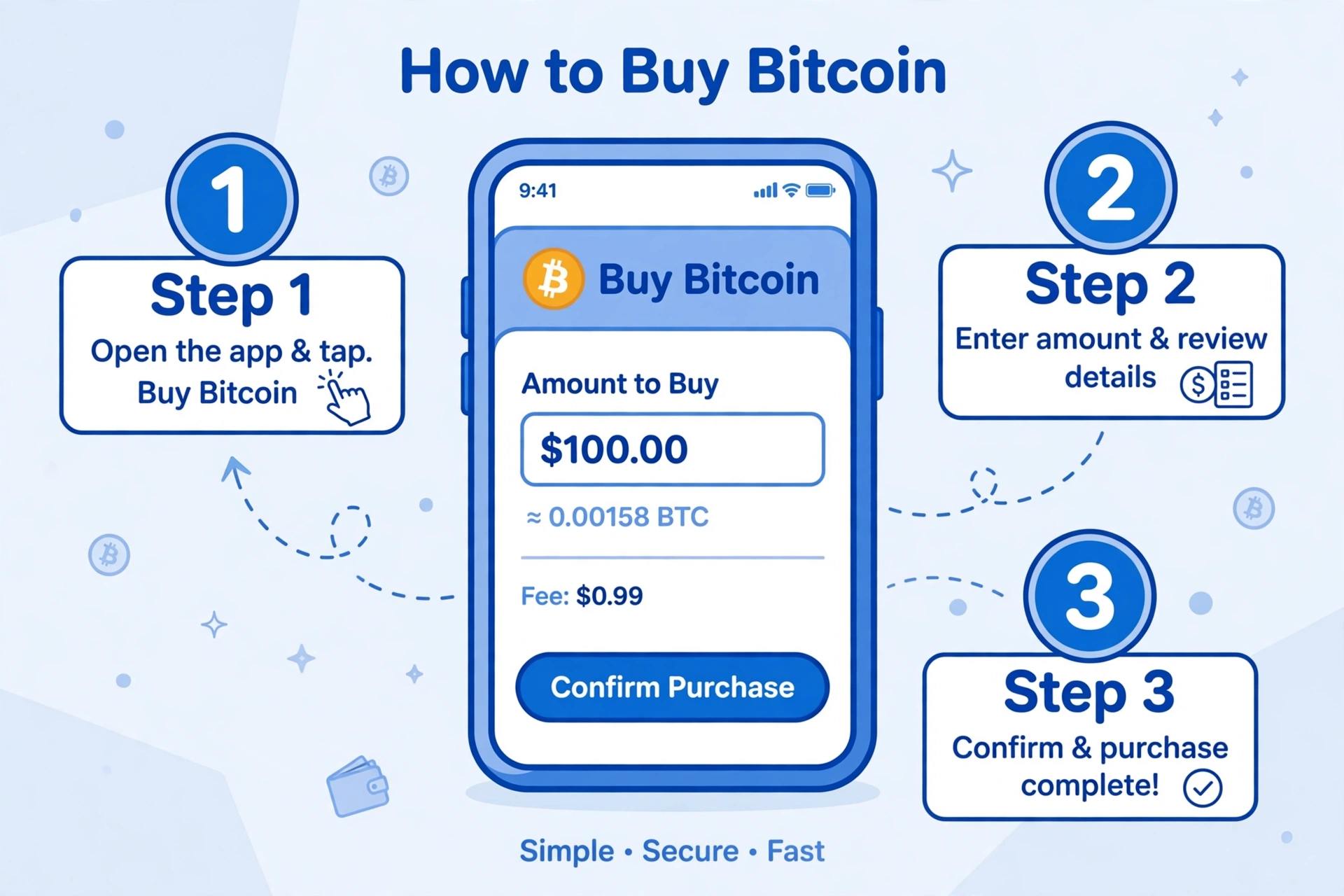
So, you want to buy your first Bitcoin. Nice. But where do you even start? Which app? How much money? What if you mess it up?
Relax. Buying Bitcoin is way simpler than it sounds — honestly, ordering a pizza online is harder. This guide will walk you through it step by step, in plain words, with zero jargon. By the end, you will know exactly what to do (and what to avoid). Ready? Let’s go.
Before You Spend a Single Dollar: What You Need (And What You Don’t)
First, the good news: you do not need to buy a whole Bitcoin. A whole Bitcoin costs tens of thousands of dollars. But you can buy a tiny slice of one — even $10 worth. That slice is real Bitcoin, just a smaller piece of it. (The smallest piece is called a satoshi, and there are 100 million of them in one Bitcoin. But you don’t need to remember that — just know that small amounts are totally fine.)
What you do need:
- A phone or a computer.
- An ID (like a passport or driving licence).
- A bank account or a debit card.
- A small amount of money you can afford to lose. This is the big one — only use money that would not ruin your month if it disappeared. Crypto prices go up and down fast, so never use rent money, bill money, or borrowed money. Ever.
What you don’t need: any technical knowledge, a fancy computer, or a finance degree. If you can use an app, you can buy Bitcoin.
Where to Buy: Exchange vs App vs ATM — What’s the Difference?
You have got three main options. Here they are, in plain words:
A crypto exchange (like Coinbase or Binance) is the most common way. Think of it like a big online shop for crypto. You make an account, add money, and buy. They usually have the most choice and the lowest fees. This is what most beginners use.
A payment app (like Cash App or PayPal, where available) is the easiest way. If you already use the app, buying Bitcoin can take about two minutes. The trade-off: fewer choices, and sometimes higher fees.
A Bitcoin ATM is a real machine, like a cash machine, that sells Bitcoin. You put cash in, it sends Bitcoin to your wallet. It works, but the fees are usually the highest of the three. Good in a pinch, not the best for regular buying.
Our honest take? For your first buy, a well-known exchange or a payment app you already trust is the simplest route. Don’t overthink it. You can always change later.
Setting Up Your Account and Locking It Down
Once you pick where to buy, you will make an account. It is like signing up for anything else — email, password, done. But then do these three things before you buy anything:
1. Use a strong password. Not your dog’s name. Not the same password you use everywhere else. A long one, with letters, numbers, and a symbol. A password manager can help if remembering is a pain.
2. Turn on two-factor authentication (2FA). This is a second lock on your account. Even if someone guesses your password, they still can’t get in without the code from your phone. Most apps offer it — use an authenticator app (like Google Authenticator) rather than text messages if you can, because text messages can be faked more easily.
3. Check the web address. If you ever get an email or a message with a link to your exchange, don’t click it. Type the address yourself. Fake login pages are one of the oldest tricks in the book, and they look scarily real.
Did you know? A huge share of crypto thefts start with a fake login page or a fake “support” message — not with someone hacking the exchange itself. Your account is only as safe as your password and your 2FA. Locking those down is the single most useful thing you can do today.
Why Do They Ask for Your ID? (And What to Expect)
Here is the part that surprises most beginners: the exchange will ask for your ID. A photo of your passport or driving licence, and sometimes a selfie. It feels weird. Why does buying Bitcoin need all this?
The short answer: the law. Legitimate exchanges have to check who their customers are — the same way a bank does when you open an account. It is called KYC (“know your customer”), and it is there to stop money laundering and fraud. A real exchange will always ask for it. If a place lets you buy with no ID at all, that is a red flag, not a bonus.
What to expect: you upload a photo of your ID, take a quick selfie, and wait. Verification usually takes a few minutes to a day. Sometimes the photo gets rejected because it is blurry — just retake it in good light. Annoying, but normal.
Adding Money and Placing Your First Order
Okay, account ready. Now the fun part. You add money from your bank account or debit card, just like topping up any app. Bank transfers are usually cheaper; cards are usually faster.
Then you buy. You will see two types of orders. Here they are, in one paragraph each:
Market order: you buy at the current price, right now. Simple, fast, done. This is what most beginners should use for their first buy.
Limit order: you set the price you are willing to pay, and the order only goes through if the price drops to that level. It is useful later, but you don’t need it on day one.
For your first time, just do a small market order. Type in the amount — say $20 or $50 — hit buy, and that’s it. You now own Bitcoin. Congratulations! (Feels good, right?)
After You Buy: Leave It on the Exchange, or Move It to Your Own Wallet?
Here is a question every beginner asks next. When you buy Bitcoin on an exchange, it sits in the exchange’s wallet. That is fine for small amounts and for learning. But there is a famous saying in crypto: “not your keys, not your coins.”
What does that mean? A wallet does not actually store your Bitcoin — it stores your private keys, the secret codes that prove the Bitcoin is yours. If the exchange holds those keys, the exchange is in control. If you move your Bitcoin to your own wallet, you hold the keys, and you are in control.
So, the simple rule: small amounts while you are learning? Leaving them on a big, well-known exchange is okay. Bigger amounts, or money you plan to hold for years? Move it to your own wallet. We explain the whole thing in our wallets guide.
Also read: Best Crypto Wallets for Beginners — hot wallets vs cold wallets, explained like you are five.
The 5 Mistakes Every First-Time Buyer Makes (And How to Dodge Them)
Mistake 1: Putting in too much money. Start small. You can always add more later. You cannot un-spend money.
Mistake 2: Buying because of hype. If everyone is shouting “buy now, it’s going to the moon!”, that is the worst time to rush in. Hype is not a plan.
Mistake 3: Panic selling when the price drops. Prices fall. It happens. Selling in a panic usually means selling at the lowest point. If you want the calm version of this talk, read our crash guide.
Mistake 4: Clicking links from strangers. Fake “support” accounts, fake giveaways, fake “double your Bitcoin” offers — they are everywhere, especially on social media. Never click, never send.
Mistake 5: Sharing your seed phrase. When you set up your own wallet, you will get a seed phrase — 12 or 24 words that can recover your wallet. Never share it with anyone. Not support, not a friend, not a website. Anyone with those words owns your crypto.
Also read: Crypto Scams: How to Spot Them Before They Get You — the tricks, in plain words, so you can dodge them.
So, What Now?
You know what you need, where to buy, how to lock your account down, why they ask for ID, how to place an order, and where to keep your coins after. That is genuinely everything you need for your first buy.
Start small. Stay calm. And remember — you don’t have to understand everything about crypto to buy your first bit of Bitcoin. You just have to understand enough to do it safely. And now, you do.
Curious how Bitcoin is different from Ethereum? That is a great next read — it will help you understand what you actually bought.
Also read: Bitcoin vs Ethereum: What’s the Difference? — the two big coins, side by side, in plain English.
A quick note: This article is for learning only — it is not financial advice, and we are not telling you to buy anything. Crypto is volatile, prices can fall a lot, and you can lose money. Only use money you can afford to lose, and never borrow money to buy crypto.