I still remember the exact moment I bought my first meme coin.
It was 2021, late at night, and my phone was blowing up with messages from a group chat. Everyone was talking about some coin called Shiba Inu. “It’s the next Dogecoin.” “People are already up 400%.” “Get in before it’s too late.”
I told myself I’d just put in a small amount. Just to see what happens. Just for fun.
Three clicks on Binance, and I had skin in the game.
What followed was the most emotionally exhausting two weeks of my investing life. I watched it go up 60%, felt like a genius, didn’t sell. Watched it drop 40% back down, felt sick, still didn’t sell. Watched it go up again, felt relieved. Eventually sold at roughly where I started — technically not a loss, but not a gain either, and definitely not worth the stress.
I learned more about my own psychology in those two weeks than from any investing book I’d read.
If you’re curious about meme coins — what they actually are, how they work, why people make and lose fortunes on them, and what you need to know before touching one — here’s the honest version.
What Even Is a Meme Coin?
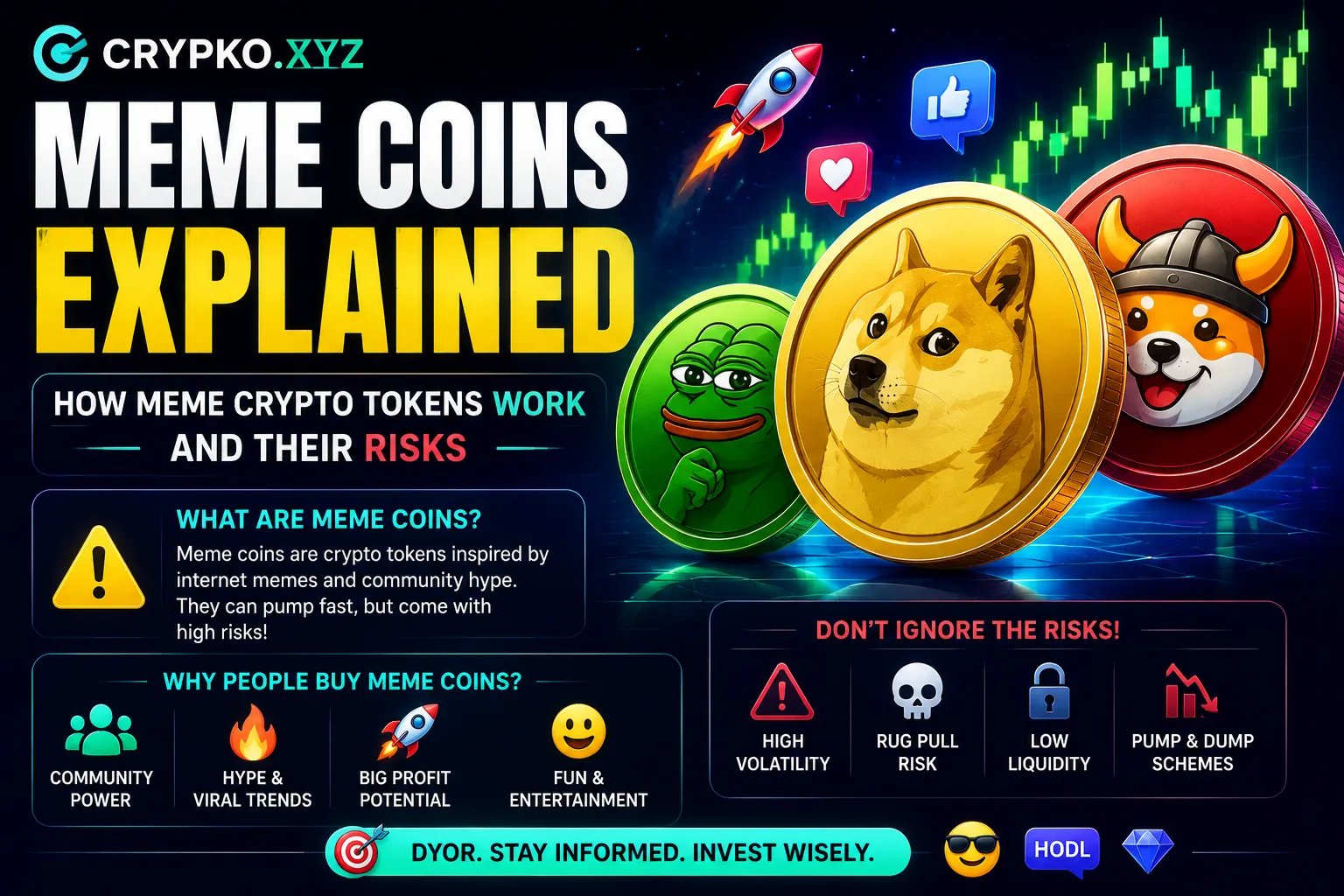
A meme coin is a cryptocurrency that started as — or is primarily driven by — internet culture, jokes, and community hype rather than technical innovation or real-world utility.
Dogecoin is the original. It literally started as a joke in 2013, based on the “Doge” meme of a Shiba Inu dog with funny captions. The two developers who created it have said publicly they didn’t expect anyone to take it seriously.
Then Elon Musk started tweeting about it. And suddenly people were millionaires.
That pattern — joke token, viral moment, massive price spike, equally massive crash — has repeated itself dozens of times since. Shiba Inu, Pepe, Floki, Bonk, Dogwifhat, Brett, Popcat — each one followed a similar arc to varying degrees.
The honest answer to “what is a meme coin” is this: it’s a speculative token whose value is almost entirely driven by community sentiment, social media momentum, and the greater fool theory — the idea that you can profit by selling to someone willing to pay more than you did, regardless of underlying value.
That’s not necessarily a reason to avoid them entirely. But it’s the reality you need to understand going in.
How Do Meme Coins Actually Work?
Most meme coins are technically simple. Unlike Bitcoin (which has complex proof-of-work mining) or Ethereum (which runs an entire ecosystem of applications), most meme coins are just tokens launched on an existing blockchain.
Dogecoin runs on its own blockchain. But most of the newer generation — Shiba Inu, Pepe, the endless stream of tokens launching daily — run on Ethereum, Solana, or BNB Chain. Launching a token on these networks takes maybe an hour and very little money.
This is important to understand: creating a meme coin requires almost no technical skill. Platforms like Pump.fun on Solana made it so anyone could launch a token in minutes. Thousands of new tokens launch every single day. The vast majority go to zero within days or hours.
Here’s the basic lifecycle of most meme coins:
Launch — A token gets created and initial liquidity is added. Sometimes there’s a “presale” where early buyers get tokens cheaply before public trading.
Hype phase — The community promotes it on Twitter, Telegram, Reddit, TikTok. Influencers get paid (sometimes disclosed, often not) to mention it. Price starts climbing.
FOMO phase — People see the price going up, fear missing out, buy in. This pushes the price further. Charts look incredible. The community is euphoric.
Distribution phase — Early holders and the team start selling into the buying pressure. Price slows down. Some people notice the chart “topping out.”
Dump — Large holders sell significant positions. Price drops sharply. Buyers from the FOMO phase are now holding bags at a loss.
Death spiral or recovery — Most coins continue declining to near zero. A small number stabilize and find genuine communities that sustain them long-term.
Dogecoin and Shiba Inu are unusual survivors. For every one of them, there are thousands of tokens that completed the lifecycle above and left their late buyers with worthless tokens.
The Real Reason People Keep Buying Them
Here’s something I had to be honest with myself about: the appeal of meme coins isn’t irrational. The math actually works — for some people.
If you bought Dogecoin in January 2021 and sold in May 2021, you turned $1,000 into roughly $100,000. If you bought Pepe in its first week of trading in 2023, the gains were even more extreme.
Those stories are real. They happened. The problem is they create survivorship bias — we hear about the people who won because they’re loudly celebrating on social media. We don’t hear nearly as much from the much larger group who bought late, held through the crash, and lost most of what they put in.
The other appeal is the community aspect. Meme coin communities — especially around Dogecoin and Shiba Inu — are genuinely fun, welcoming, and energetic. There’s a social element that pure investment vehicles don’t have. For some people, even a small meme coin holding feels like being part of something.
Both of these things can be true: meme coins have created real wealth for some people AND they’ve destroyed far more wealth for many more people. Keeping both facts in your head simultaneously is the only way to approach them clearly.
The Risks — And They’re Serious
Let me go through these one by one because each is real and each has burned people I know personally.
Rug Pulls
A rug pull is when the developers of a meme coin abandon the project and take the liquidity with them — leaving holders with worthless tokens and no way to sell.
It works like this: developers create a token, hype it up, attract buyers, then drain the liquidity pool (the funds that allow trading) and disappear. Your tokens still exist in your wallet. They just can’t be sold for anything.
Rug pulls happen constantly in the meme coin space. The anonymity of crypto development makes it easy to do and difficult to prosecute. Some are obvious in hindsight — anonymous team, no audit, no locked liquidity. Others are more sophisticated.
There are tools to check for basic rug pull indicators — Token Sniffer, RugCheck.xyz, and DEXTools all show things like whether liquidity is locked, whether the top holders control a dangerous percentage of supply, and whether the contract has suspicious functions that allow the developer to mint new tokens or restrict selling.
None of these tools are foolproof, but checking them takes two minutes and filters out the most obvious scams.
Honeypots
A honeypot is a specific type of scam where the token contract allows buying but not selling. You can watch the price go up. You just can’t get out.
You’d think this would be obvious, but it’s not. The token looks and trades normally at first. Only when you try to sell do you discover the restriction in the contract. By then, the developers have already extracted the liquidity.
Again — Token Sniffer and RugCheck flag many of these. Always check before buying anything on a decentralized exchange.
Pump and Dump Coordinated Groups
Telegram and Discord are full of groups promising “insider calls” on the next big meme coin. They’ll announce a token, everyone in the group buys simultaneously to spike the price, then the group organizers (who bought before the announcement) sell into the artificial pump.
The people who follow the call late are left holding a token that’s already peaked. The organizers make money consistently. The followers occasionally win (if they sell fast enough) and frequently lose.
I was in a few of these groups early on out of curiosity. The psychology is fascinating and disturbing. The announcements create genuine excitement. People post gains in real time. The FOMO is engineered and extremely effective.
Extreme Volatility
Even legitimate meme coins with real communities can drop 70–90% in a matter of days. Dogecoin dropped 74% in about two months after its 2021 peak. Shiba Inu lost over 80% from its all-time high within months.
If you invest money you can’t afford to lose and this happens, the emotional pressure to sell at the worst moment is immense. Most people do sell at the worst moment. This is how ordinary people lose significant money in meme coins — not from rug pulls, but just from panic-selling during normal (for meme coins) drawdowns.
Tax Complications
Every meme coin trade is potentially a taxable event in most countries. If you’re trading dozens of meme coins — which is common in the space — the tax reporting alone becomes a nightmare.
I know someone who made decent overall gains from meme coins but ended up owing more in taxes than they expected because they hadn’t tracked their cost basis on hundreds of small trades. Use Koinly or CoinTracker from day one if you’re going to be active in this space.
How to Approach Meme Coins Without Destroying Yourself
If after reading all of the above you still want to participate — which is a completely reasonable choice — here’s how to do it with some structure:
Set a hard limit before you start. Decide the maximum amount you’re willing to lose completely — because that is a realistic outcome. Treat it like buying a ticket to a casino, not like investing. I personally cap any meme coin exposure at 2–3% of my total crypto portfolio. If it goes to zero, uncomfortable but survivable.
Buy established ones if you want lower (relative) risk. Dogecoin and Shiba Inu are not safe investments, but they have survived multiple market cycles, have real community bases, and are listed on major regulated exchanges. They’re a different risk profile from a token that launched yesterday on Pump.fun.
Use DEXTools or DexScreener to research new tokens. Before buying anything on a decentralized exchange, check the chart for unusual patterns (giant spike immediately after launch often means insiders front-ran it), check the holder distribution (if the top 10 wallets hold 60%+ of supply, that’s a problem), and check the liquidity amount (very low liquidity means price can be moved dramatically by small trades).
Always check RugCheck.xyz or Token Sniffer. Paste the contract address. Read the warnings. Take them seriously.
Set a take-profit target before you buy. Decide: if this goes up 3x, I’m selling at least half. If this goes up 10x, I’m selling most of it. Write it down. Then actually do it when it hits. The number of people who rode a 10x back to zero because they got greedy is staggering.
Never buy based on a Telegram call or influencer shill without doing your own check first. The time pressure is manufactured. There is almost never a real reason you need to buy in the next five minutes.
Use a separate wallet for meme coin activity. Keep your main holdings in one wallet, your meme coin speculation in a completely separate wallet. This is both for security (you’re interacting with more sketchy contracts) and for mental clarity.
The Platforms and Tools Worth Knowing
Pump.fun — Where a massive percentage of Solana meme coins launch. Browsing it gives you a real-time view of how many tokens are being created every hour. It’s genuinely eye-opening.
DexScreener — Real-time charts and data for tokens on decentralized exchanges. Shows new pairs, trading volume, liquidity, and large transactions. Essential if you’re watching meme coins.
DEXTools — Similar to DexScreener, slightly different interface. Many traders use both.
RugCheck.xyz — Solana token safety checker. Paste a contract address, get a risk report.
Token Sniffer — Works across multiple chains. Checks for common scam indicators in token contracts.
Phantom Wallet — If you’re buying Solana meme coins, this is the standard wallet. Clean interface, widely supported.
MetaMask — For Ethereum-based meme coins. The standard.
Mistakes I’ve Watched People Make (Including Myself)
Putting in more than planned because “it’s already going up.” This is how a fun small bet becomes a significant loss.
Not selling any on the way up. Watching a 5x become a 10x and then back to 2x because you kept waiting for more. Partial profits are real profits.
Getting emotionally attached to a community. The community being fun and supportive is not a reason to hold through catastrophic losses. Communities can be great and the token can still go to zero.
Buying the “recovery dip” repeatedly. A token that’s crashed 80% can crash another 80% from there. Down 80% is not automatically a buying opportunity.
Ignoring the contract details entirely. Buying a token just because the name is funny without spending two minutes on RugCheck is how people get rugged.
Talking friends and family into it. I made this mistake once. A friend put in money based on my enthusiasm, lost most of it, and it was awkward for months. Only speak for your own positions.
The Honest Bottom Line
Meme coins are one of the most purely speculative things you can do in crypto. They operate almost entirely on sentiment and timing. A small number of people make extraordinary gains. A much larger number of people lose money — usually because they arrived late, got greedy, or trusted the wrong sources.
That doesn’t make them off-limits. But it makes treating them like “investing” a mistake. They’re speculation at its purest form. Going in with that mindset — eyes open, amount you can afford to lose completely, clear exit plan — is the only way to participate without it becoming genuinely damaging.
The person who made money on Dogecoin in 2021 and the person who lost money on a random Solana token in 2024 were probably operating with very similar feelings of confidence. The difference was timing, and some luck.
Know what you’re doing and why. Keep it small. And when your target hits — actually sell.