A few months ago, a friend texted me: “Bro, should I buy TAO? Everyone on my Discord is going crazy about it.”
I told him I’d get back to him. Then I spent the next week going down a rabbit hole that fundamentally changed how I think about both AI and crypto. Not because TAO made me rich — it didn’t — but because I finally understood why a category called “AI crypto” even exists, and what’s actually behind these tokens beyond the hype.
If you’ve been hearing terms like “AI tokens,” “Bittensor,” “decentralized AI compute,” or “RNDR” floating around and you’re not sure what any of it means — this is the article I wish I had read first. No jargon overload. No moonshot promises. Just a real walkthrough of what’s going on.
Wait — Why Would AI Need Its Own Crypto?
This was my first question too. And it’s the right one.
Right now, almost all the AI you use — ChatGPT, Gemini, Midjourney, Copilot — runs on infrastructure owned by a handful of massive companies. OpenAI, Google, Microsoft, Amazon. They control the GPUs, the data centers, the models, and increasingly, the rules.
AI crypto projects essentially ask: what if that wasn’t the case? What if AI training, AI compute, and AI data could all be sourced from a decentralized network — where anyone with a powerful GPU or useful dataset could contribute and get paid for it?
That’s the core pitch. And honestly? It’s not crazy. The GPU shortage is real. The centralization of AI is real. And blockchain provides a way to reward distributed contributions without a central authority running the show.
Whether it’ll work at scale is still being figured out. But the building is actively happening — and that’s what makes this space interesting right now.
The Different Types of AI Tokens
Before diving into specific coins, it helps to understand that “AI crypto” isn’t one single thing. There are several distinct categories:
Decentralized AI training networks — AI models compete and get rewarded for performance (Bittensor is the main example here).
GPU/compute marketplaces — People rent out their unused GPU power and get paid in tokens (Render, Akash Network).
AI agent platforms — Autonomous AI bots that can transact, earn money, and coordinate on-chain (Fetch.ai, Virtuals Protocol).
Data markets — People sell datasets used for AI training (Ocean Protocol, Grass).
AI-friendly blockchains — Layer 1 networks with built-in AI features and infrastructure (NEAR Protocol, Internet Computer).
Knowing which layer you’re looking at matters a lot. Buying a GPU marketplace token is a completely different bet from buying an AI agent platform token. Understanding the difference saves you from a lot of bad decisions.
Top AI Tokens Beginners Should Know in 2026
I’m not going to rank these by “most likely to 10x” because I genuinely don’t know, and anyone who claims to is lying to you. I’m listing them based on how clearly I can explain what they actually do — because for a beginner, that’s the only metric that matters.
1. Bittensor (TAO)
Bittensor is the one that started the whole conversation for me. Think of it as a competitive arena for AI models. Developers submit their AI models to the network, and those models get judged on performance. The better your model performs, the more TAO tokens you earn.
It has a hard cap of 21 million tokens — same as Bitcoin — and went through a halving event in late 2025, cutting daily token emissions in half. The network runs on a subnet architecture that now supports specialized AI tasks ranging from detection to serverless compute.
TAO is consistently the largest AI crypto by market cap. It surged over 100% in a single 30-day window in early 2026. Still extremely volatile, but it’s building real infrastructure — not just wearing the AI label.
2. Render Network (RNDR)
Render lets people with idle GPUs rent them out for AI workloads and 3D rendering jobs. If you’ve ever used Blender, Stable Diffusion, or any AI image generation tool, you know how GPU-hungry these tasks are. Render is essentially a marketplace connecting GPU owners with people who need that compute — no AWS middleman required.
It has real usage in the film industry and generative AI pipelines, and it tends to move in correlation with GPU-related news — including Nvidia announcements. The GPU shortage is structural, not temporary, which is what makes this project’s thesis compelling long-term.
3. Artificial Superintelligence Alliance — ASI / Fetch.ai (FET)
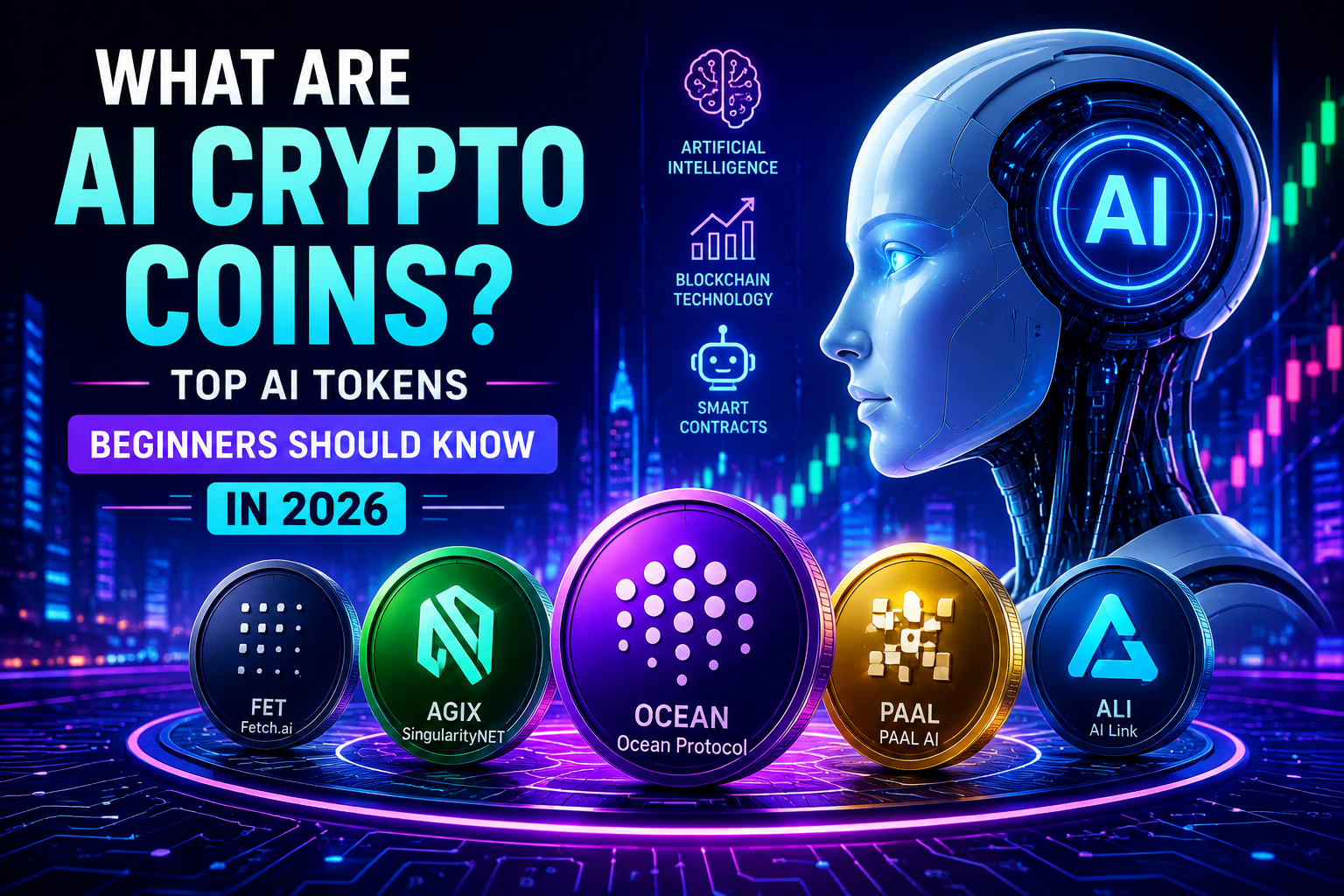
Fetch.ai merged with SingularityNET and Ocean Protocol to form the Artificial Superintelligence Alliance. Each project covers a different piece of the AI puzzle:
- Fetch.ai builds autonomous AI agents that can negotiate and transact on their own
- SingularityNET is a marketplace for AI services
- Ocean Protocol handles data monetization for AI training
The merger reduces fragmentation and aligns three ecosystems under one token. The downside: it’s complex, the tokenomics shifted post-merger, and combining three communities isn’t always smooth. But the combined coverage of agents, services, and data is arguably the most complete AI stack in the crypto space.
4. NEAR Protocol (NEAR)
NEAR is a Layer 1 smart contract blockchain that has gone all-in on AI as its primary use case. Its “Chain Abstraction” approach is designed to let AI agents interact across different blockchains without friction — which matters as the agent economy grows.
Developer activity on NEAR is consistently high, and it sits near the top of AI crypto rankings by market cap. Because it’s an established Layer 1 (not a single-use token), it carries somewhat less risk than some of the more niche AI projects — though “less risky” in crypto is always relative.
5. Virtuals Protocol (VIRTUAL)
Virtuals is one of the newer names but it’s gaining serious momentum. It’s a platform where anyone can create, launch, and monetize AI agents — without needing to write code. Each AI agent gets its own token, can earn revenue through apps, games, and DeFi platforms, and is tradeable.
Think of it as the launchpad economy for AI agents. It expanded to multiple blockchains in early 2026 and is consistently near the top of the AI agent category by market cap. It’s genuinely novel — and genuinely speculative. The tokenized AI agent model is experimental, and that cuts both ways.
6. Internet Computer (ICP)
ICP lets developers run full applications — including AI models — directly on a blockchain, without using traditional cloud servers at all. The vision is ambitious: replace AWS and Google Cloud with a decentralized network.
Developer activity on ICP is among the highest in the entire AI crypto space — over 200 meaningful code commits per day measured in early 2026. That’s a strong signal that real building is happening. ICP has had a turbulent price history since its launch, so it rewards patience and research over quick trades.
How to Actually Buy AI Crypto Tokens — Step by Step
Here’s the practical process I’d walk a complete beginner through:
Step 1 — Pick a regulated exchange. For most people, Coinbase, Binance, or Kraken is the right starting point. Most major AI tokens (TAO, NEAR, RNDR, FET) are listed on at least two of these platforms. Create an account and complete identity verification — it takes 15 to 30 minutes.
Step 2 — Start with a small amount. Treat your first purchase as paying for an education, not making an investment. A small amount — whatever feels genuinely disposable to you — teaches you how wallets, transactions, and volatility feel in real life. No video or article can replicate that experience.
Step 3 — Look at usage, not just price. CoinGecko’s AI category page tracks market cap and trading volume. But go further — look at developer activity on GitHub, check actual network transactions, and find out whether people outside of crypto circles are using the product.
Step 4 — For smaller tokens, use a DEX. Some AI tokens are only available on decentralized exchanges like Uniswap or Raydium. This means you’ll need a wallet (MetaMask is the most common) and some ETH or SOL to cover gas fees. It’s a slightly steeper learning curve but opens up a wider range of projects.
Step 5 — Use a hardware wallet for long-term holdings. Ledger and Trezor both support most major AI tokens. If you’re holding anything significant, keeping assets off an exchange is just good practice.
Mistakes I Made (And See Others Make Constantly)
Buying a token just because it has “AI” in the name. The AI crypto market has over 900 tokens tracked on CoinGecko. Most have nothing to do with real AI infrastructure. Some are outright scams wearing a trendy label. If you can’t explain in one sentence what the token is actually used for, don’t buy it.
Ignoring token dilution. Some AI projects release large quantities of new tokens over time. This inflates the supply and puts downward pressure on price — even if the underlying project is doing well. Always check the fully diluted valuation versus the current market cap. A large gap between the two is a warning sign.
Expecting decentralized AI to beat OpenAI next year. Most of these networks are still early-stage and competing with companies that have billions in funding and years of head start. The decentralized bet might pay off over a longer time horizon. Don’t plan your finances around it happening quickly.
Treating Discord hype as research. Community enthusiasm is a useful signal, but it’s not due diligence. Read the actual documentation, look at GitHub activity, and actively seek out critical takes — not just the bullish posts. The bear case is always more useful when you’re deciding whether to buy.
Buying your full position at once. These tokens are extremely volatile. Dollar-cost averaging — buying small, fixed amounts on a regular schedule instead of one lump sum — smooths out risk significantly. It’s boring advice. It works anyway.
Is This Space Actually Worth Paying Attention To?
Yes — but with eyes open.
The AI crypto market crossed $20 billion in total market cap in 2026, driven by real demand for decentralized AI compute. Meanwhile, centralized AI fundraising keeps reminding people how concentrated the space is getting. There’s genuine appetite for alternatives.
The concentration of quality within AI crypto is also striking. Developer activity in the space is heavily concentrated in the top few projects. The rest are largely inactive. Most AI tokens are noise — a handful are genuine signal.
The signal ones — Bittensor, NEAR, Render, and a few others — are building real infrastructure. That doesn’t guarantee their prices go up. Markets are unpredictable and timing is nearly impossible. But there’s something real underneath, which is more than you can say for most corners of the crypto market.
A Few Resources Worth Bookmarking
CoinGecko’s AI category — real-time market caps with category filtering. Free and reliable.
Messari — detailed sector research and quarterly reports. The free tier covers a lot.
Santiment — developer activity metrics and on-chain data. Good for filtering projects that are all marketing and no building.
Each project’s official documentation — Bittensor’s docs, NEAR’s developer hub, Render’s site. Reading primary sources beats most YouTube explainers.
Search “[project name] problems” or “[project name] concerns” on X/Twitter — this surfaces the bear case quickly, which is always more valuable for due diligence than the bull case.
My friend eventually bought a small amount of TAO. He’s up a bit, down a bit, and mostly just learning — which is exactly the right outcome for a first crypto purchase. He now understands what he bought and why people think it matters. That’s worth more than any short-term price swing.
That’s the honest starting point for AI crypto in 2026. Not a get-rich scheme. Not a guaranteed moonshot. A genuinely interesting technological bet — with real ideas behind it, real risks in front of it, and worth understanding before you put a single rupee into it.
Start small. Think long. Read the documentation.