The first time I used a stablecoin, I didn’t even realize that’s what I was doing.
I was trying to send money to a friend in another country. Bank transfer was going to take 3–5 business days and eat up a chunk in fees. Someone in a crypto group suggested I just send USDT. I downloaded Trust Wallet, figured out how to buy USDT on Binance, sent it across in about four minutes, and my friend received it almost instantly.
I remember thinking — wait, that’s it? No waiting. No ridiculous conversion fees. No “your transfer is being reviewed” message.
That was my introduction to stablecoins. And since then, I’ve used them constantly — for saving, for moving money across borders, for parking funds between crypto trades, and once, accidentally, on the wrong blockchain network (more on that painful story later).
If you’ve heard the term but aren’t sure what stablecoins actually are, which one to use, or whether the newer ones are worth trusting — this is the honest breakdown I wish I’d had from the start.
So What Even Is a Stablecoin?
Regular crypto like Bitcoin or Ethereum moves wildly. One day you’re up 20%, the next you’re down 30%. That’s great if you’re speculating, but terrible if you’re just trying to hold value or pay someone.
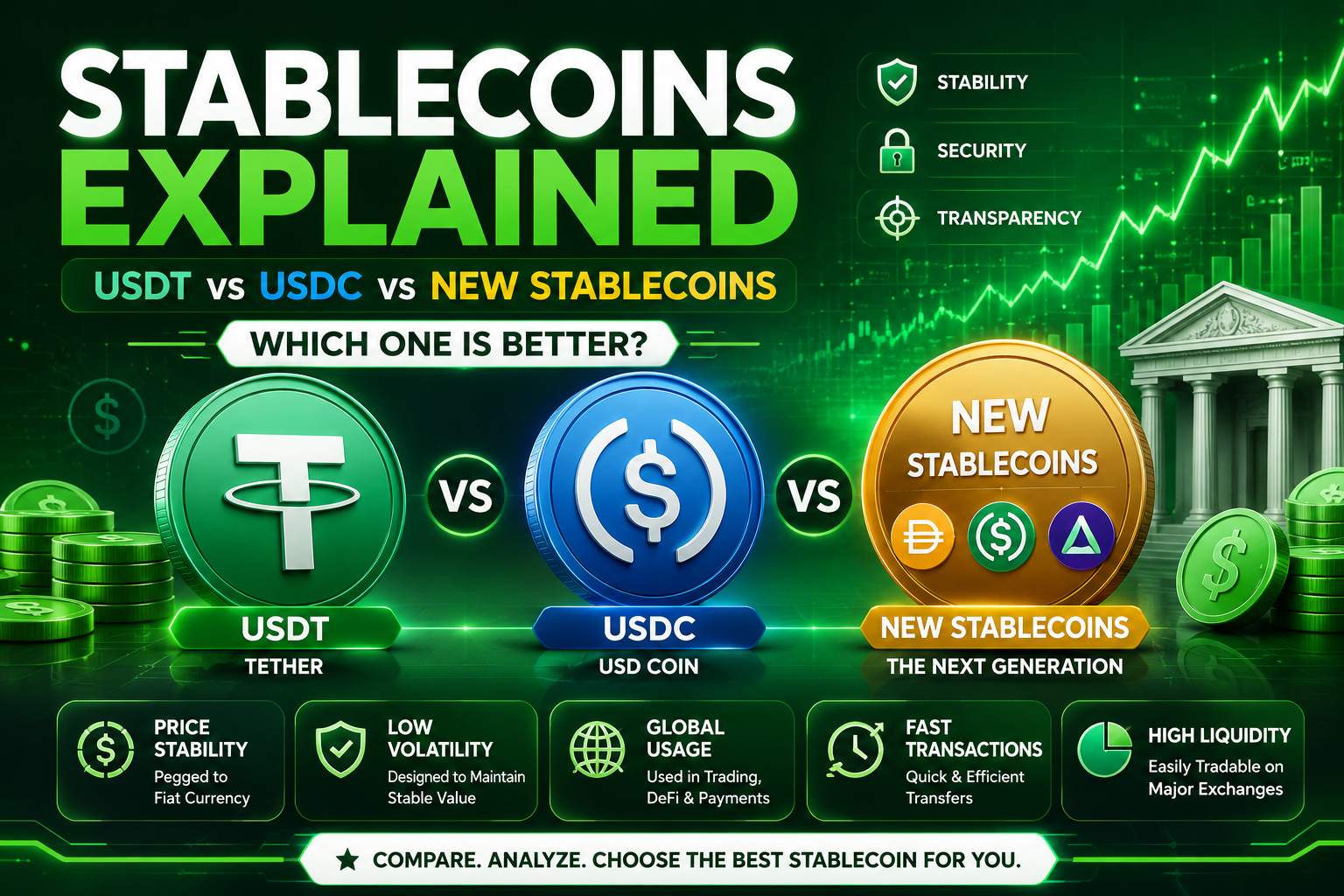
Stablecoins solve that problem by being pegged to a stable asset — almost always the US Dollar. One USDT is meant to always be worth $1. One USDC is meant to always be worth $1. The price doesn’t swing around like regular crypto.
This makes them incredibly useful for:
- Sending money internationally without conversion headaches
- Parking your crypto profits without converting back to your local currency
- Trading between crypto pairs without going in and out of fiat
- Earning yield in DeFi platforms
- Getting paid or paying someone in crypto without worrying about price swings
They’re basically digital dollars that live on a blockchain. That’s the simplest way to think about it.
USDT (Tether) — The One Everyone Uses
USDT, issued by a company called Tether, is the oldest and most widely used stablecoin in the world. By a massive margin. It’s available on virtually every exchange, every blockchain, every DeFi platform you’ll ever touch.
When I first started using stablecoins, I used USDT purely because it was the only option listed on the platforms I was using. That’s still true for a lot of people — especially on exchanges popular in Asia, the Middle East, and Africa.
What’s good about USDT:
It’s everywhere. Binance, OKX, Bybit, KuCoin — USDT pairs dominate. Liquidity is enormous, which means buying and selling at your intended price is rarely an issue. For peer-to-peer transfers and remittances, it’s the default choice in most of the world.
What’s not so good:
Tether has had a complicated history with transparency. For years, there were legitimate questions about whether they actually held enough real dollars to back every USDT in circulation. They’ve improved their reporting since then and publish regular attestations, but full independent audits have been slow to come. The trust is based largely on track record and market confidence — not on the kind of verified, audited proof that some people would prefer.
For everyday use — sending money, trading, parking funds short-term — most people don’t lose sleep over this. But it’s worth knowing.
USDC (USD Coin) — The Transparent Alternative
USDC is issued by Circle, in partnership with Coinbase. It launched a few years after USDT and positioned itself from day one as the “clean” stablecoin — fully backed by cash and short-term US Treasury bonds, with regular third-party audits by major accounting firms.
I switched a portion of my stablecoin holdings to USDC after reading more about how each one was backed. For long-term holding, the transparency just felt more comfortable.
What’s good about USDC:
The reserves are verifiable. Circle publishes monthly attestations from Grant Thornton (a major accounting firm), and the backing is genuinely held in regulated US financial institutions. It’s also the stablecoin of choice in a lot of regulated financial applications, US-based DeFi protocols, and institutional platforms.
If you’re using stablecoins in the US or Western Europe, USDC will often feel more “official.” Coinbase users get it natively, and it integrates cleanly with a lot of fintech apps.
What’s not so great:
USDC had a scary moment in March 2023 when Silicon Valley Bank collapsed. Circle had about $3.3 billion of USDC’s reserves sitting in SVB. USDC briefly de-pegged to around $0.87 before the US government stepped in to guarantee deposits. It recovered fully within days, but it was a reminder that “backed by real dollars in real banks” isn’t risk-free either — the banks themselves can fail.
Also, USDC is slightly less available than USDT on exchanges outside the US. Not a dealbreaker, but worth checking for your specific platforms.
USDT vs USDC — A Direct Comparison
Here’s how they stack up across the things that actually matter for everyday use:
Availability: USDT wins. It’s on more exchanges, more blockchains, and more peer-to-peer platforms globally.
Transparency: USDC wins. Verified audits, clearer reserve reporting, stronger regulatory alignment.
Liquidity: Both are enormous. USDT has higher trading volume overall, but USDC is deep enough for virtually any transaction size a regular person would make.
Trust history: Both have had their moments. USDT’s reserve controversy, USDC’s SVB scare. Neither is “risk-free.”
DeFi usage: Depends on the protocol. US-based DeFi tends to favor USDC. International protocols often use USDT.
Best for sending money internationally: USDT, purely because recipients and exchanges in most of the world default to it.
Best for holding longer term: USDC, purely for the verified backing.
Honestly, most people who use crypto regularly hold both. I do.
The Newer Stablecoins Worth Knowing About
The stablecoin market didn’t stop at USDT and USDC. Several newer players have emerged with different models and interesting approaches.
DAI (now USDS) — Decentralized and crypto-backed
DAI is issued by MakerDAO (which rebranded to Sky Protocol) and works differently from USDT and USDC. Instead of being backed by dollars in a bank, DAI is backed by crypto assets locked in smart contracts. There’s no company holding your reserves — it’s all on-chain and verifiable in real time.
The trade-off: because it’s backed by volatile crypto, it requires overcollateralization — you lock up more value than you borrow. It’s more complex to understand, but it’s genuinely decentralized in a way USDT and USDC are not.
PYUSD — PayPal’s stablecoin
PayPal launched its own stablecoin, PYUSD, issued by Paxos. For people who are already in the PayPal ecosystem, it’s an interesting option. It’s fully regulated and backed by US dollar deposits and treasuries. It’s still relatively small compared to USDT and USDC, but PayPal’s reach could change that over time.
FDUSD — First Digital USD
FDUSD emerged as Binance’s preferred stablecoin after some regulatory friction with BUSD. It’s backed by cash equivalents and is primarily used within the Binance ecosystem. Liquidity on Binance is strong for it. Outside of Binance, less so.
USDe — Ethena’s synthetic dollar
This one is newer and works through a different mechanism entirely — it uses derivatives and hedging strategies rather than simple dollar reserves. It’s generated a lot of attention in DeFi circles because of its yield potential. It’s also more complex and carries different risks than traditional backed stablecoins. Worth researching if you’re deep in DeFi, but probably not for beginners.
That Painful Mistake I Mentioned Earlier
Okay, story time. This is important.
Early on, I sent USDT to a friend. I copied their wallet address, selected USDT, and hit send. A few minutes later they messaged me saying they hadn’t received anything.
What happened: I sent USDT on the Ethereum network (ERC-20). Their wallet was set up to receive on the Tron network (TRC-20). Same token, different blockchain, completely different address format — and the funds ended up in limbo.
We eventually recovered them, but it took time, technical help, and a lot of stress.
The lesson: network selection matters as much as the token itself. Always confirm with the recipient which network they want to receive on. The most common options for USDT are:
- TRC-20 (Tron network) — cheapest fees, fastest, most common for peer-to-peer transfers
- ERC-20 (Ethereum) — higher fees, widely supported
- BEP-20 (BNB Chain) — low fees, common on Binance
When in doubt, ask before sending. The two seconds it takes to confirm can save you a massive headache.
How to Choose the Right Stablecoin for Your Situation
For sending money to family abroad: USDT on TRC-20. Low fees, fast, and most recipients’ wallets or exchanges already support it.
For holding savings in crypto: USDC if you want audited transparency. Split between USDT and USDC if you want diversification.
For using DeFi protocols: Check what the protocol prefers. Many US-based protocols incentivize USDC. Many international ones run primarily on USDT. DAI/USDS is worth exploring if you want the decentralized version.
For trading on exchanges: Whatever has the best liquidity pairs on your exchange. On Binance, usually USDT. On Coinbase, usually USDC.
For complete beginners: Start with USDC on Coinbase. The interface is clean, the stablecoin is transparent, and you don’t have to worry about network selection complexity right away.
Platforms I Actually Use
A few tools worth knowing:
Coinbase — Easiest for beginners. USDC is native here and earns a small yield automatically on the platform.
Binance — Best for USDT liquidity and international transfers. Huge range of networks supported.
Trust Wallet / MetaMask — Self-custody wallets. Good once you’re comfortable managing your own keys.
Curve Finance — If you’re in DeFi and want to swap between stablecoins with minimal slippage, this is the go-to.
Aave / Compound — If you want to earn yield on your stablecoins through lending protocols.
Common Mistakes to Avoid
Sending on the wrong network — Already covered this. Double-check every time.
Assuming all stablecoins are identical — They’re not. Different backing, different risks, different availability. Know what you hold.
Leaving large amounts on exchanges — Exchanges can get hacked, freeze withdrawals, or go under. For significant holdings, a hardware wallet (Ledger, Trezor) is worth it.
Chasing high stablecoin yields without understanding the risk — If someone is offering you 20%+ annual yield on a stablecoin, something unusual is happening. It’s not magic — there’s risk somewhere in the mechanism. Understand it before depositing.
Not accounting for fees when sending small amounts — Sending $10 of USDT on Ethereum can cost $5 in gas fees. Always check the network fee before hitting confirm.
Which One Is Actually Better?
There’s no clean single answer — it genuinely depends on what you’re doing.
For global availability and peer-to-peer transfers: USDT. For verified reserves and regulatory comfort: USDC. For truly decentralized holding: DAI/USDS. For PayPal users easing into crypto: PYUSD.
Most people who use stablecoins regularly end up holding two or three of these for different purposes. That’s not indecision — that’s just how the ecosystem works in practice.
The real insight after using these for a while: the stablecoin itself matters less than understanding the network you’re using, the platform you’re on, and the purpose you have. Get those three things right, and the choice between USDT and USDC becomes pretty manageable.
Start small. Learn one platform first. And always — always — confirm the network before you send.
Disclaimer: This article is for informational purposes only and does not constitute financial advice. Stablecoins carry risks including de-pegging, reserve failures, and regulatory changes. Always do your own research before using or investing in any cryptocurrency.