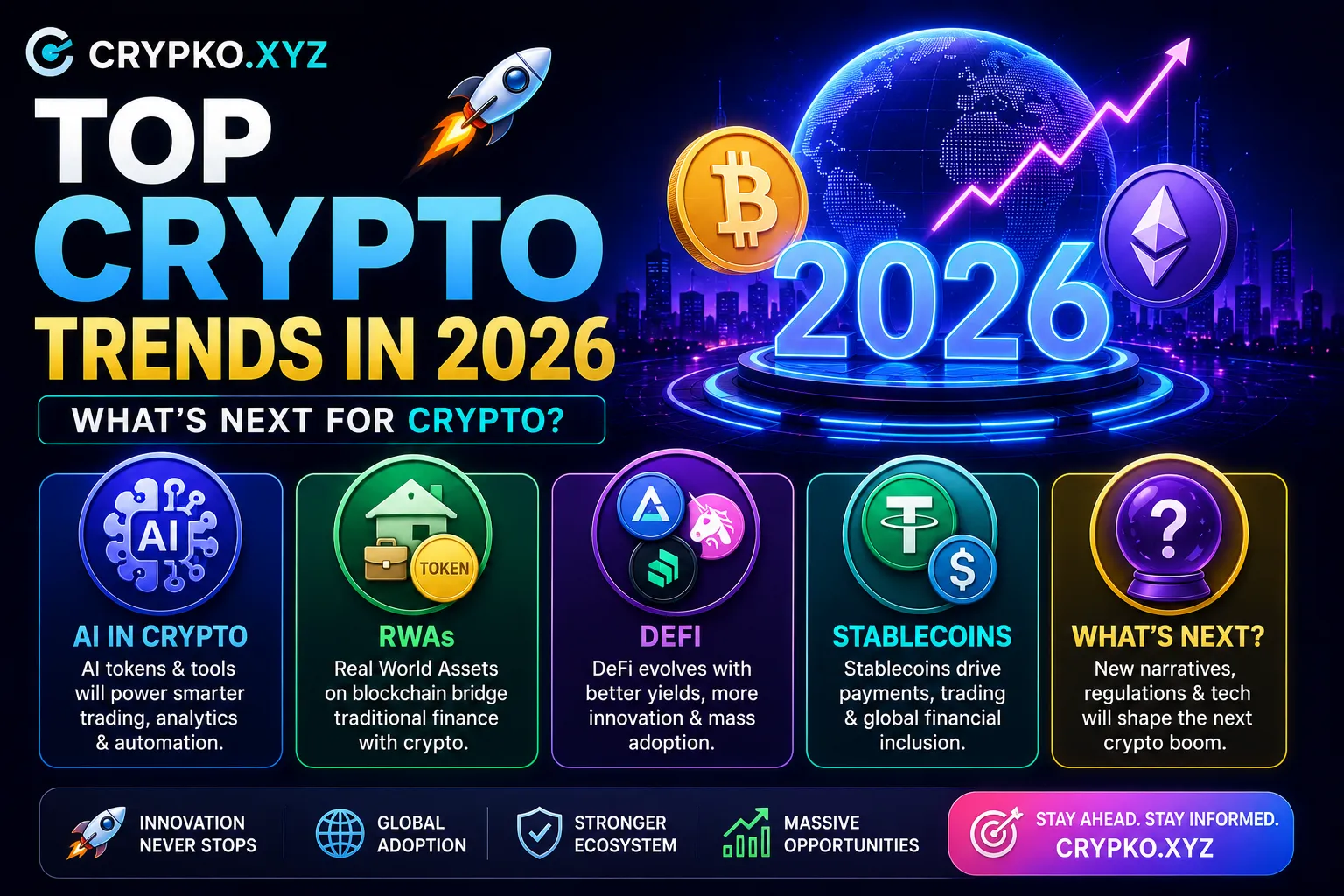
Sitting at my desk in January this year, trying to figure out what to actually pay attention to in crypto, I made myself a short list.
Not a price prediction list. Not a “top 10 coins to buy” list. Just a list of the underlying shifts that seemed like they were actually changing something real — not just generating Twitter excitement for a few weeks before disappearing.
I’ve been in crypto long enough to know the difference between a narrative and a trend. Narratives are stories people tell to justify price movements. Trends are things that are actually building, quietly, even when prices aren’t moving.
In 2026, for the first time in a while, the trends feel genuinely different from the previous cycles. This isn’t the NFT summer of 2021. It’s not the DeFi explosion of 2020 where everything was held together with duct tape and hoped-for smart contract audits. What’s happening now is slower, less flashy — and probably more significant because of that.
Here’s what I’ve been watching closely, what’s actually worth understanding, and what I think it means for regular investors.
The Mood Has Shifted — And That Matters
Before getting into specific sectors, it’s worth noting the overall atmosphere.
The total cryptocurrency market cap in April 2026 consolidated around $3.5 trillion. And unlike the 2021 bull run, which was fueled by stimulus checks and retail FOMO, the current market is supported by what analysts are calling “Three Pillars of Stability”: spot ETFs, sovereign adoption, and enterprise-grade DeFi. KuCoin
That’s a genuinely different foundation. The buyers now include BlackRock, Franklin Templeton, and sovereign wealth funds alongside retail. When institutions this size start building infrastructure — not just buying and holding but actually building — it changes the risk profile of the space.
Analysts at Grayscale and Bitwise have been calling for a “sustained bull market” driven by institutional demand rather than the old halving-driven boom-bust cycle. Medium
Whether that thesis holds is unknowable. But the structural shift in who’s participating is real and observable, not just a prediction.
Trend 1: Real-World Assets — The Biggest Quiet Revolution
RWAs — Real-World Assets — is the trend I’ve become most convinced about. Not because the token prices are exciting, but because the underlying numbers are genuinely remarkable.
The idea is straightforward: take traditional financial assets — Treasury bills, bonds, real estate, private credit — and represent them as tokens on a blockchain. This makes them tradeable 24/7, composable with DeFi protocols, and accessible without the friction of traditional financial infrastructure.
The tokenized RWA market hit $34.5 billion in May 2026, up over 100% year-on-year. BlackRock, Ondo Finance, and Circle are leading institutional adoption, and Standard Chartered projects the tokenized asset market to reach $30 trillion by 2034. Bitcoin News
That’s not a small number. And it’s not speculative crypto money — it’s traditional finance moving onto blockchain rails.
BlackRock’s USD Institutional Digital Liquidity Fund (BUIDL), tokenized by Securitize, accumulated over $2.1 billion in assets. Ondo Finance’s products collectively surpassed $2.1 billion in total value locked. Medium
What makes this interesting for regular investors isn’t necessarily buying RWA tokens themselves. It’s understanding that the infrastructure connecting traditional finance to blockchain is being built right now — by the largest financial institutions in the world. That’s a different kind of validation than any crypto project can manufacture.
In 2026, the focus is shifting from simple tokenized Treasuries to private credit (approximately $17 billion tokenized) and tokenized real estate. Platforms like Ondo Finance and Centrifuge allow users to lend stablecoins to real-world businesses, earning yields that are decoupled from crypto volatility. CoinGecko
That last part matters — yield that doesn’t depend on crypto prices going up. That’s genuinely new for DeFi.
In a notable milestone, BlackRock’s BUIDL fund entered DeFi rails via Uniswap — the first time a major asset manager connected a regulated tokenized fund to a decentralized exchange. Franklin Templeton also partnered with Ondo Finance to launch tokenized versions of five ETFs, tradeable 24/7 via crypto wallets. Investax
When BlackRock lists a fund on Uniswap, the “DeFi vs TradFi” framing stops making sense. They’re merging.
Trend 2: Stablecoins Becoming Financial Infrastructure
When I sent USDT to a friend overseas last year, I thought of stablecoins as a convenience tool. A way to move money faster than a bank transfer.
That framing is too small for what’s happening in 2026.
Stablecoins are moving from a loosely defined crypto category into a more formal financial infrastructure layer. Enterprise and institutional interest is no longer limited to crypto-native firms. StablecoinInsider
Stablecoins are becoming business payment infrastructure — cutting currency conversion costs and delays, reducing intermediaries, and supporting faster cross-border settlement. Governments are testing public finance on-chain through tokenized bonds. Mercuryo
PayPal has its own stablecoin. Visa and Mastercard are integrating stablecoin settlement. The EU’s MiCA framework has created formal regulatory categories for stablecoin issuers. The US is moving toward its own stablecoin legislation.
Smart contracts can already settle a dollar payment globally in seconds. But emerging primitives in 2026 make that settlement programmable and reactive — AI agents paying each other for data, GPU time, or API calls instantly and permissionlessly, without invoicing, reconciling, or batching. a16z crypto
That last sentence is wild to think about. The combination of stablecoins and AI agents means software can now earn money, pay for services, and settle contracts — autonomously, in real time. That’s a genuinely new capability that didn’t exist a few years ago.
For regular investors, the stablecoin story matters less as a speculative opportunity and more as infrastructure to understand. The rails are being built. What runs on those rails — the applications, the businesses, the financial products — is where the opportunity eventually concentrates.
Trend 3: AI + Crypto — Still Early, but Genuinely Different Now
I wrote about AI crypto tokens separately, so I won’t rehash every project here. But the meta-trend is worth understanding clearly.
The first wave of “AI crypto” in 2023–2024 was largely narrative-driven. Projects slapped “AI” into their name and watched their token price respond to ChatGPT headlines. Most of those tokens have been forgotten.
What’s different in 2026 is that the integration is becoming functional rather than cosmetic.
Technologies that once felt futuristic — AI managing portfolios, decentralized chatbots, tokenizing real-world assets — are now focused on making crypto easier to use and more practical for everyday investors and institutions. Mercuryo
The specific use cases gaining real traction:
AI agents transacting on-chain. Autonomous AI programs that hold wallets, earn revenue, and pay for services without human intervention. Fetch.ai and Virtuals Protocol are building this infrastructure. In a world where systems act on intent instead of step-by-step instructions — moving money because an AI agent recognized a need or triggered an outcome — value has to travel as fast and freely as information does today. a16z crypto
Decentralized AI compute. Networks like Bittensor, Render, and Akash where anyone can contribute GPU power and get paid for it. With AI compute demand exploding and centralized cloud providers struggling to keep up, the decentralized alternative is gaining real interest from developers who need cheaper, available compute.
AI-powered trading and analysis. DeFi protocols using AI to optimize yield, manage risk, and route transactions. Not as flashy as “buy this AI token,” but quietly changing how DeFi actually functions.
The honest caveat: this remains a space where separating genuine utility from narrative is hard. The projects building real infrastructure are worth tracking. The tokens riding AI headlines without underlying technology are not.
Trend 4: DeFi Growing Up
DeFi had its wild adolescent phase. The 2020–2021 period was genuinely chaotic — extraordinary yields that turned out to be unsustainable, protocols getting exploited for hundreds of millions, anonymous teams disappearing with funds.
A lot of that has been shaken out. What remains — and what’s growing — looks meaningfully more mature.
DeFi is no longer a side experiment. The market hit $42.7 billion in 2025 and is projected to reach $178 billion by 2029. Institutional players like BlackRock are now involved. Troniex Technologies
The specific developments worth noting:
Real yield is replacing manufactured yield. Earlier DeFi attracted users with token emissions — essentially paying people in newly created tokens to provide liquidity. This created the illusion of high yields that eventually collapsed. The new generation of DeFi protocols earns yield from actual economic activity — lending to real businesses, generating fees from real trading volume, collecting interest from real borrowers.
Lending protocols are becoming serious. Aave, Morpho, and Compound are no longer considered experimental. They have years of battle-tested security, meaningful liquidity, and increasingly, institutional users.
DeFi tools like Morpho Vaults automatically allocate assets into lending markets with the best risk-adjusted yield — providing a core yield-bearing allocation in a portfolio. a16z crypto
Regulatory clarity is arriving. This sounds boring but it’s crucial. The EU’s MiCA framework is fully operational. The US is moving toward clearer rules. When regulations are uncertain, institutional money stays out. When regulations clarify — even if they’re strict — institutions can comply and participate. That’s what’s happening now.
Trend 5: Layer 2 Networks — The Scalability Problem Is Being Solved
This is probably the least exciting trend to write about but arguably the most practically important.
Ethereum mainnet transactions still cost real money in gas fees. During busy periods, sending a transaction or interacting with a DeFi protocol can cost $20–50. That pricing is incompatible with mainstream adoption.
Layer 2 networks — Arbitrum, Optimism, Base, zkSync, Polygon — solve this by processing transactions off the main Ethereum chain and periodically settling back to it. The result: transactions that cost a fraction of a cent, with essentially the same security guarantees.
Base, built by Coinbase, has grown remarkably fast and has become a hub for the new generation of consumer crypto applications. Arbitrum hosts some of the most actively used DeFi protocols. zkSync and Starknet are pushing toward even more efficient architectures.
The practical implication: if you haven’t moved your DeFi activity to Layer 2 yet, check L2Fees.info and see what you’ve been paying unnecessarily. The savings are immediate and significant.
Trend 6: Institutional Bitcoin — ETFs Changed Everything
This one deserves mention even if it feels like old news at this point.
Bitcoin ETFs launched in early 2024 and the cumulative flows since then have been staggering. BlackRock’s IBIT became one of the fastest ETFs to reach $10 billion in history. Every major financial advisor now has a mechanism to allocate client funds to Bitcoin without the custody headaches.
The implication isn’t just price-related. It’s structural. Bitcoin has gone from an asset that financial advisors were forbidden to recommend to one that shows up in legitimate portfolio allocation conversations alongside stocks and bonds.
That doesn’t make Bitcoin’s price go straight up. It means the volatility profile changes over time as the holder base broadens and the percentage held by long-term institutional investors grows.
For regular investors, this matters because the “is Bitcoin legitimate” question has been definitively answered by the market. The question now is how much allocation makes sense for your situation — not whether it belongs in a portfolio at all.
What to Actually Do With This Information
Trends are useless if you don’t have a practical response to them. Here’s how I’m personally thinking about each:
RWAs — I’m watching Ondo Finance’s products and paying attention to which DeFi protocols are integrating tokenized Treasuries as collateral. If you want yield that doesn’t depend on crypto prices, this is where it increasingly comes from.
Stablecoins — I split holdings between USDC (for verified backing) and USDT (for liquidity and P2P transfers). Nothing complicated here — just understanding what you’re holding and why.
AI crypto — Small allocation to established projects with genuine infrastructure (TAO, NEAR, RNDR). Treating it as speculative and sizing accordingly. Not chasing new AI token launches without deep research.
DeFi — Using Aave on Arbitrum for stablecoin lending. Checking Morpho for yield optimization. Staying on Layer 2 for anything that doesn’t specifically require mainnet.
Layer 2 — All DeFi activity on Arbitrum or Base. Mainnet only for large, infrequent transactions where the fee is proportionally small.
Bitcoin — Long-term hold. Not trying to time it. Understanding that the institutional entry makes it both more stable and less likely to produce the dramatic short-term gains of earlier cycles.
Mistakes I’ve Seen People Make With Trend-Chasing
Buying the trend narrative instead of the underlying utility. RWA tokens surging because “RWA is hot” is not the same as RWA technology being transformative. The technology can be real while the specific token you bought is overvalued.
Rotating too aggressively between narratives. Selling DeFi tokens to buy AI tokens to buy RWA tokens is mostly generating tax events and transaction costs. Identify what you believe in long-term and hold it, with patience.
Confusing institutional participation with guaranteed upside. BlackRock being involved in Bitcoin ETFs and RWA tokenization doesn’t mean prices only go up. Institutions also sell.
Ignoring the boring infrastructure trends in favor of exciting speculative ones. Layer 2 scaling and regulatory clarity aren’t as exciting as a new AI token launch. But they’re what makes the whole ecosystem function long-term.
Waiting for certainty. The time when a trend feels “safe enough” to enter is usually the time when most of the early upside has already happened. Uncertainty is the cost of early positioning.
The most interesting thing about crypto in 2026 isn’t any single trend. It’s that multiple serious structural shifts are happening simultaneously — institutional capital, regulatory clarity, AI integration, real-world asset tokenization, and maturing DeFi infrastructure all at once.
That doesn’t make it risk-free. The volatility is still real. The scams are still numerous. The tokens that will go to zero still outnumber the ones that won’t.
But the underlying direction feels less like a speculative bubble and more like an industry that’s finding out what it’s actually for. That’s a different kind of exciting — slower, more durable, and ultimately more interesting than watching a meme coin go up 400% for a week.
Pay attention to what’s being built. The prices will figure themselves out.