A friend of mine lost ₹80,000 in about eleven minutes last year.
Not from a market crash. Not from a bad trade. From clicking a link in a Discord server he’d been part of for three months. The server looked legitimate — it had thousands of members, active moderators, regular announcements. The link looked like an official NFT mint from a project he’d been following.
He connected his wallet. Clicked approve. And watched his entire wallet drain in real time.
By the time he realized what happened and revoked the permissions, it was already over. The scammer had moved the funds through multiple wallets and into a mixer within minutes. Completely untraceable. Completely gone.
He’s not a crypto newbie either. He’d been in the space for two years, knew about basic security, kept his main holdings on a hardware wallet. The scammer caught him in a moment of excitement — a project he actually liked, an announcement that looked real, a quick click without thinking.
That story has stuck with me because it stripped away the comforting idea that “if you know enough, you won’t get scammed.” The scams have gotten too good for that to be true anymore. The only real protection is understanding specifically how each type works — so that even in a moment of excitement, something trips your alarm.
Here’s everything that’s currently being used to steal from crypto users, explained as clearly as I can.
How Scams Have Evolved — And Why They’re Harder to Spot Now
The early crypto scams were embarrassingly obvious. Nigerian prince emails with crypto. “Send 1 ETH, get 2 back” from fake Elon Musk accounts. Promises of guaranteed 50% monthly returns.
Those still exist, and they still catch people. But the sophisticated end of the scam ecosystem has evolved enormously.
AI-generated websites that are indistinguishable from the real thing. Compromised official Discord and Twitter accounts spreading malicious links. Smart contracts with carefully hidden malicious functions. Fake customer support that already knows your account details. Social engineering that builds trust over weeks before the actual hit.
The 2026 version of crypto scams is a professional industry with specialization, tooling, and scale. Understanding that changes how you need to think about protection.
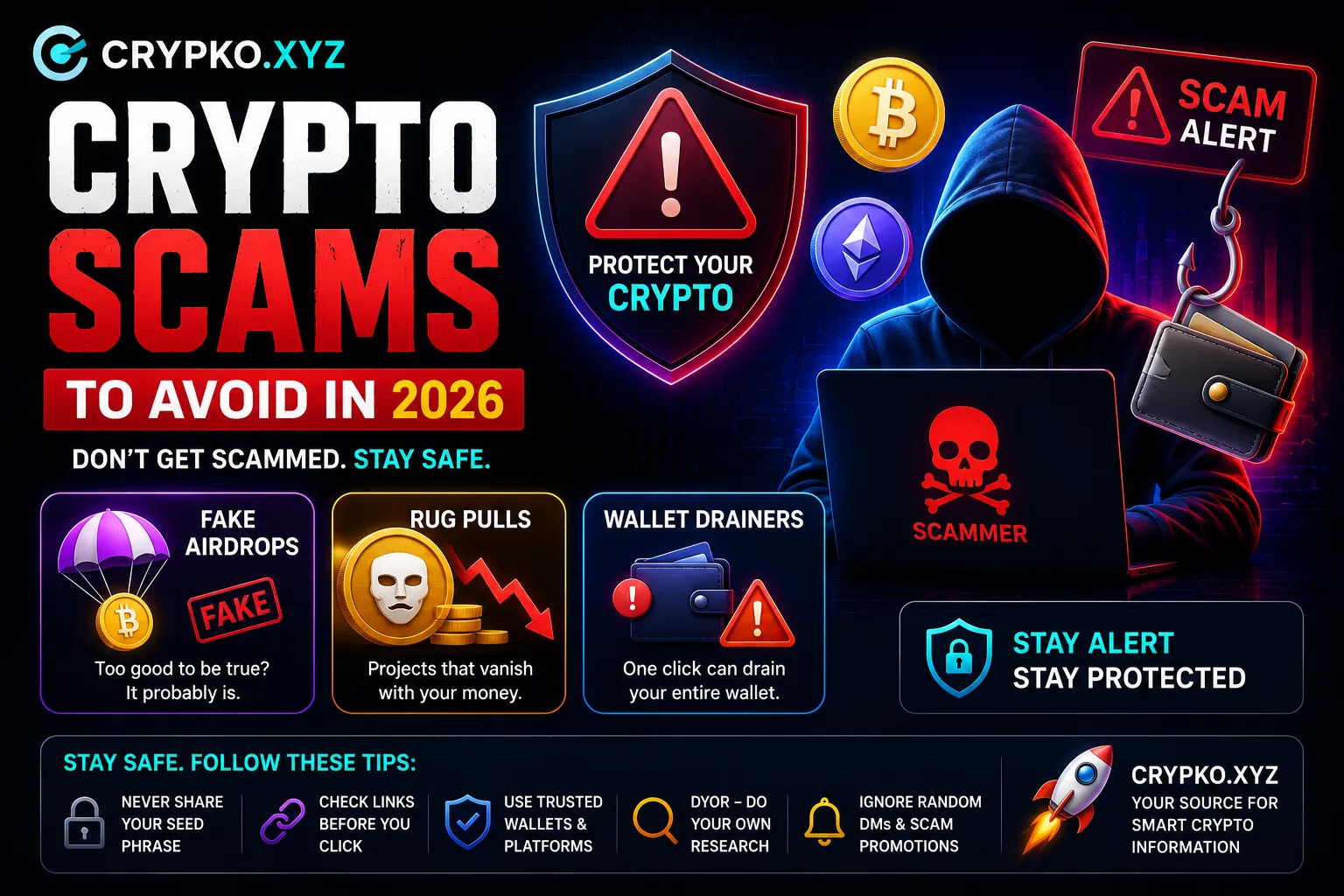
Scam Type 1: Wallet Drainers — The Most Dangerous Thing in Crypto Right Now
A wallet drainer is a malicious smart contract that, when you interact with it, transfers everything in your wallet to the scammer’s address. The whole thing happens in seconds. There’s no “undo.”
Here’s exactly how it works:
You see a link — in Discord, on Twitter, via a DM, sometimes even in Google ads — that looks like a legitimate website. Maybe it’s a mint for an NFT project you follow. Maybe it’s a DeFi platform offering a special yield opportunity. Maybe it looks like the Uniswap interface or a token claim page.
You connect your wallet. This part looks completely normal — connecting wallets to websites is something you do legitimately all the time.
Then you’re asked to sign a transaction or approve a permission. This is where the scam executes. The transaction you’re approving isn’t what it appears to be. Hidden in the smart contract is a function that authorizes the drainer contract to move all your tokens — sometimes not just the ones you see in your main wallet, but any token the contract can reach.
You click confirm. The drainer executes. Wallet empty.
The most common delivery mechanisms:
Discord compromise — a project’s official Discord gets hacked, and the scammer posts a malicious link as an “urgent announcement” pinned in the announcements channel. Because it’s coming from the official server, people trust it.
Twitter/X account hacks — verified project accounts get compromised and post fake mint links. The checkmark and follower count make them look legitimate.
Google ads — this one surprised me when I first learned about it. Scammers buy Google ads for search terms like “Uniswap,” “MetaMask,” or “OpenSea.” The ad appears above the real website. Unsuspecting users click the ad, land on a pixel-perfect fake, connect their wallet, and get drained.
Always type DeFi website URLs directly. Never click them from search results or ads.
How to protect yourself:
Before connecting your wallet to any website, check the URL character by character. Drainer sites use tricks like “unlswap.com,” “uniswαp.com” (with a Greek alpha), or “uniswap-official.com” — URLs that look right at a glance but aren’t.
Use Wallet Guard or Pocket Universe — browser extensions that simulate transactions before you sign them, showing you what a transaction will actually do to your wallet. This single tool would have saved my friend. It costs nothing and takes five minutes to install.
Regularly audit and revoke token approvals at Revoke.cash. Every time you interact with a DeFi protocol, you may have granted it permission to access your tokens. These permissions don’t expire automatically. Checking and revoking old approvals is basic hygiene that most people skip.
Keep most of your holdings in a hardware wallet (Ledger, Trezor) that is never used to interact with new, unverified protocols. Have a separate “hot wallet” with only what you need for active DeFi use.
Scam Type 2: Fake Airdrops — Free Money That Costs Everything
Airdrops are a legitimate marketing tool. Projects send free tokens to wallet addresses to build community and generate awareness. Real airdrops from real projects happen all the time.
Scammers have built an entire ecosystem around faking them.
The setup: you check your wallet one day and see a token you didn’t buy. It might have a name like “Claim 1000 USDC” or impersonate a real project — “Arbitrum Season 2 Airdrop” or “Uniswap V4 Launch Reward.” The balance might show something impressive — $500 worth of tokens, sometimes more.
The trap: the token itself is worthless. But to “claim” it or convert it, you’re directed to a website that requires connecting your wallet. Or the token’s smart contract is designed so that attempting to sell it triggers a drainer function. Or the “claim” site asks you to sign a transaction that actually approves the drainer.
Some variations require you to pay a small “gas fee” to claim the airdrop. You pay, they take the gas, you receive nothing. Small-scale but a common one.
What a legitimate airdrop looks like:
Real airdrops are announced on official project channels — verified Twitter accounts, official websites, official Discord — weeks or months in advance. You don’t randomly discover them by checking your wallet. Real airdrops never ask you to connect to a new website you haven’t heard of. Real airdrops never require you to pay anything to claim.
What to do if you find an unexpected token in your wallet:
Do not try to sell it or interact with it. Do not visit any website it links to. Search the token contract address on Etherscan or the relevant explorer and look at what other people are saying about it. Check if it’s flagged as a scam. Usually it is.
In most cases: just ignore it. Unknown tokens sitting in your wallet can’t hurt you as long as you don’t interact with them.
Scam Type 3: Rug Pulls — When the Project Was Never Real
A rug pull is when a project’s founders collect investor money, then abandon the project and disappear with the funds. The “rug” gets pulled out from under everyone who believed in it.
They exist on a spectrum from obvious to sophisticated:
The obvious version: Token launches on a decentralized exchange. Team is anonymous. No audit. No locked liquidity. Heavy promotion on social media. Price pumps. Developers drain the liquidity pool. Token price goes to zero. Team disappears.
The sophisticated version: Project builds a real-looking community over months. Has a website, a whitepaper, regular updates, active Discord, maybe even a testnet. Raises significant money through a presale or NFT mint. Then at some point — often after a major fundraising event — the team goes silent. Socials disappear. Website goes down. Funds move to mixer services and vanish.
The sophisticated version is genuinely hard to detect in advance because it looks identical to a legitimate project in its early stages.
Red flags that are worth taking seriously:
Anonymous team with no verifiable real-world presence. Promises of guaranteed returns or “risk-free” investment. Unaudited smart contracts (for any project handling significant funds, an audit from a reputable firm like CertiK, Hacken, or PeckShield is standard). Vesting schedules that give the team immediate access to all funds. Unrealistically large marketing budgets compared to development activity.
Tools that help:
RugCheck.xyz for Solana tokens — paste a contract address and get a risk breakdown including holder concentration, liquidity lock status, and known scam indicators.
Token Sniffer for Ethereum and BNB Chain tokens — similar analysis, checks for honeypot functions and suspicious contract code.
DexScreener — look at the chart. A token that launched, immediately went parabolic, and is now being watched by hundreds of fresh wallets that bought at the top is a pattern worth understanding.
Neither tool is foolproof. A sophisticated rug can pass basic automated checks. But they filter out the laziest and most obvious ones efficiently.
Scam Type 4: Pig Butchering — The Slow Burn
This is the one that makes me most uncomfortable to write about because the victims are often people who did nothing technically wrong.
Pig butchering (translated from the Mandarin “shāzhūpán”) is a long-con romance and investment scam. The structure: a scammer makes contact through a dating app, social media, or even a “wrong number” text. They build a genuine-seeming relationship over weeks or months. They eventually mention crypto — casually at first, then with increasing enthusiasm.
They share their “trading results.” They offer to help you invest. They introduce you to a platform that shows impressive returns in your account. You deposit more. You can even withdraw small amounts at first — this is deliberate, to build trust. Then when you try to withdraw a significant amount, you’re told you need to pay taxes, fees, or a deposit. Those payments disappear too. Then the person disappears.
The “platform” they introduce you to is fake — a sophisticated website that shows fake balances. The relationship was built for the sole purpose of directing you to it.
Why it works: The human relationship is real, even if the other person is playing a constructed character. Victims feel genuine connection and trust before any financial element is introduced. By the time money is involved, the skepticism that might protect them from other scams has already been bypassed.
The protection: Any romantic connection made online that eventually leads to crypto investment recommendations should be treated with extreme suspicion, regardless of how genuine the relationship feels. Legitimate romantic partners do not give investment advice. Certainly not through platforms you’ve never heard of.
If someone you’ve met online is encouraging you toward a specific crypto platform: stop, do not deposit, and tell someone you trust what’s happening before making any financial decision.
Scam Type 5: Fake Customer Support
You post in a Reddit crypto forum asking for help with a transaction. Within minutes, you get a DM from someone claiming to be “Official Support” for whatever platform you mentioned.
They’re friendly, knowledgeable-sounding, and want to help. To help you, they need your seed phrase. Or they want to share your screen. Or they send you to a “support portal” that looks official but isn’t.
The rule is absolute and has no exceptions: no legitimate platform, protocol, or exchange will ever ask for your seed phrase. Not in a DM, not on a support ticket, not on a website, not on a phone call. Never. Under any circumstances.
If anyone asks for your seed phrase, they are attempting to steal your wallet. Full stop.
Legitimate support happens through official channels only — the platform’s own support system, not through DMs from users who contacted you first.
Scam Type 6: Impersonation and Phishing
You get an email that looks like it’s from Coinbase. Same logo, same design, same tone. It says there’s unusual activity on your account and you need to verify your identity by clicking a link and logging in.
The link goes to a fake Coinbase website. You enter your email and password. The scammer now has your credentials.
Or: you search for “MetaMask download” and click the first result — which is an ad for a fake MetaMask site that installs malware or asks for your seed phrase during “setup.”
Protections that work:
Bookmark every legitimate crypto website you use and access them only from those bookmarks. Never from search results, email links, or ads.
Enable hardware security keys (like YubiKey) or authenticator apps for two-factor authentication on every exchange. SMS-based 2FA is better than nothing but can be bypassed through SIM swapping — a real and documented attack vector.
Check email sender addresses carefully. “support@coinbase-help.com” is not Coinbase. “noreply@metamask-wallet.io” is not MetaMask. Phishing emails are often nearly identical to legitimate ones except for the sender domain.
Building Your Personal Security System
After going through every scam type above, here’s the actual setup I’d recommend for someone taking security seriously:
Hardware wallet for main holdings. Ledger or Trezor. Anything you’re not actively trading or using in DeFi lives here. This device never connects to unknown sites.
Separate hot wallet for active use. MetaMask or Phantom. Only holds what you need for current activity. Treat it as semi-expendable.
Browser extensions: Wallet Guard + Revoke.cash habit. Wallet Guard simulates transactions before you sign. Check Revoke.cash monthly and revoke permissions from protocols you no longer use.
2FA on every exchange with an authenticator app. Google Authenticator or Authy. Not SMS.
Bookmark everything. Uniswap, Aave, your exchange, your portfolio tracker. Access from bookmarks only.
Pause before approving any transaction you didn’t initiate yourself. If something prompted you to connect your wallet unexpectedly, that’s the moment to stop and think before clicking anything.
Tell someone. If a financial opportunity online seems unusually good, or a new “friend” is very enthusiastic about a specific platform — tell a trusted person before putting any money in. The outside perspective cuts through the social engineering in a way that’s hard to manufacture alone.
The Mindset That Actually Protects You
Technical tools matter. But the real protection is a mindset shift.
In crypto, urgency is almost always manufactured. “Mint closes in 10 minutes.” “Only 50 spots left.” “Claim before the airdrop expires.” Real opportunities don’t disappear if you take 15 minutes to verify they’re legitimate. Scams depend on you not taking those 15 minutes.
The more excited you feel about an opportunity, the more carefully you should verify it. The excitement is often the scam working as intended.
My friend who lost his money wasn’t careless in general. He was careless in a single excited moment — and that was enough. The scammers are counting on exactly that.
Slow down. Verify everything. And remember that in crypto, there is no customer service phone number to call when something goes wrong.