A few months ago, a colleague asked me something that caught me off guard.
“Can I actually buy a piece of a Manhattan skyscraper with $100?”
My first instinct was to laugh. Real estate — especially commercial real estate in New York — has always been one of the most inaccessible asset classes for regular people. You need millions to get in, a team of lawyers to navigate the paperwork, and connections most people don’t have.
But the honest answer to her question in 2026 is: yes, actually. Not in every case and not without understanding what you’re buying. But the technical infrastructure to make that possible exists right now — and it’s called tokenization.
I’ve spent a fair amount of time this year going down the rabbit hole on this topic. Not purely out of academic interest — I actually tried using a few of these platforms and put some money into tokenized Treasury products to understand how it works in practice. Some of it surprised me. Some of it was more complicated than I expected. All of it changed how I think about what blockchain technology is actually for.
Here’s the real story of what tokenization is, what it actually means for regular investors, and what the current state of the technology looks like from someone who’s actually tried using it.
The Problem That Tokenization Is Solving
To understand why tokenization matters, you need to understand the frustration it’s responding to.
Traditional finance has always had an access problem.
The best-performing assets — commercial real estate, private credit, hedge funds, pre-IPO equity — have historically been available only to institutional investors and the very wealthy. The minimum investment for a private credit fund might be $250,000. A commercial real estate syndication might require you to be an accredited investor with documented net worth above $1 million. A Treasury bond purchased directly requires navigating government portals and understanding settlement mechanics most people have never been taught.
Even for assets that are technically accessible — public stocks, for example — the infrastructure underneath is surprisingly old and inefficient. Stock settlement in the US takes two business days (T+2). Markets close at 4pm Eastern. International investors face currency conversion friction and time zone barriers.
Blockchain doesn’t care about any of that. It settles in seconds, runs 24/7, doesn’t require a middleman to verify each transaction, and can represent any asset as a programmable token that anyone with an internet connection can potentially hold.
That gap between what traditional finance offers and what blockchain makes technically possible — that’s the opportunity tokenization is targeting.
What Tokenization Actually Means — Simply Explained
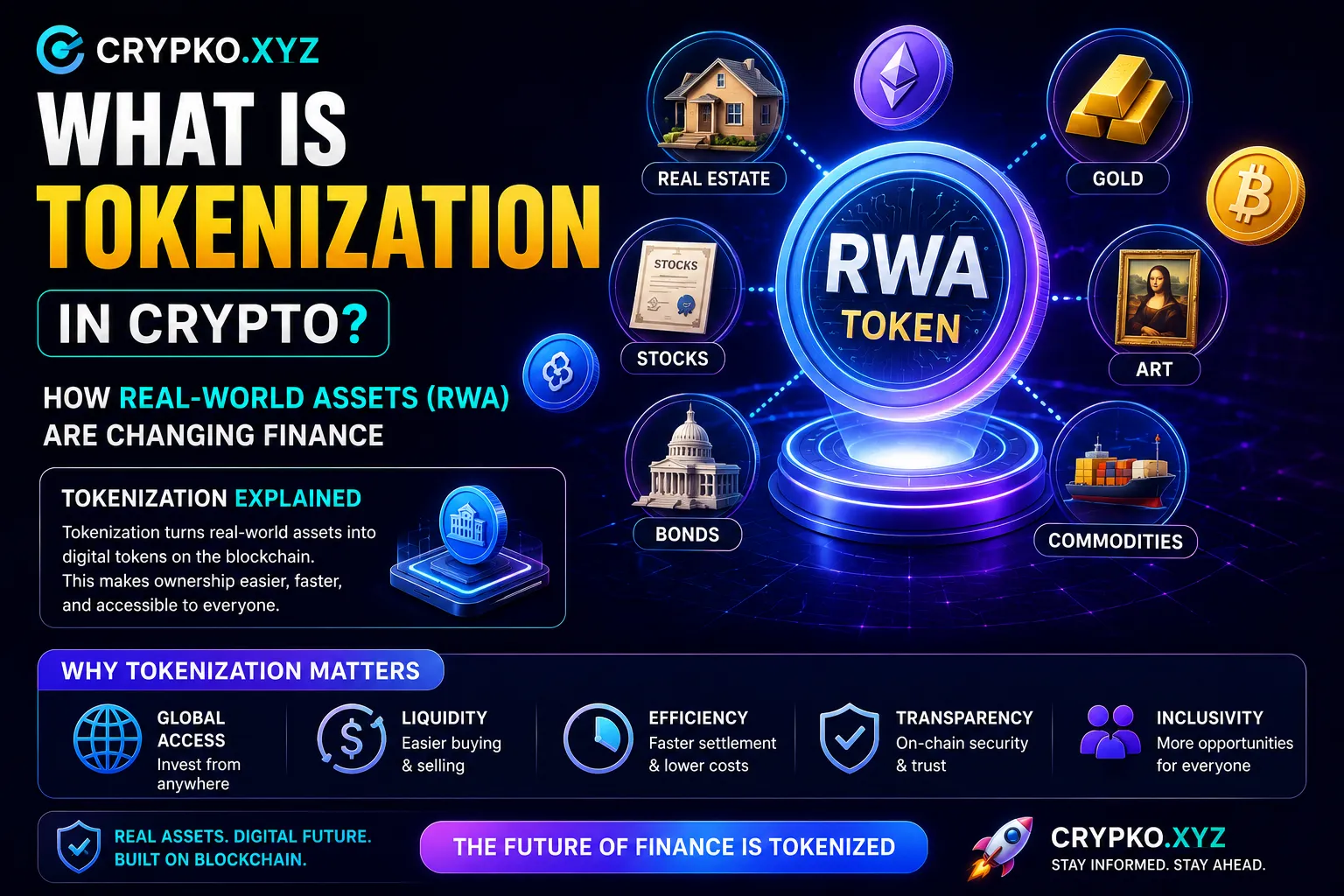
Tokenization is the process of representing ownership of a real-world asset as a digital token on a blockchain.
The asset could be anything: a government bond, a piece of real estate, a share of a private company, a commodity like gold or oil, a piece of artwork, a loan to a business, or even intellectual property rights.
When that asset is tokenized, a smart contract is created on a blockchain that represents a claim on the underlying asset. The token can then be bought, sold, transferred, or used as collateral — all with the speed and programmability of blockchain infrastructure rather than the friction of traditional finance.
The underlying asset doesn’t disappear or change. A tokenized Treasury bill is still a Treasury bill — it still earns interest, it’s still backed by the US government. The tokenization just changes how ownership is recorded and transferred.
Think of it like this: imagine a $10 million commercial building. In the traditional world, one entity owns it — or a small number of partners who each had to put in millions. With tokenization, that building’s ownership could be divided into 10 million tokens worth $1 each. Anyone could buy 100 tokens for $100 and own 0.001% of the building. The rental income gets distributed proportionally to token holders. If you want to sell your stake, you sell your tokens — no real estate agents, no 30-day closing process, no lawyers reviewing title documents.
That’s the concept. The reality is more complicated, which I’ll get to.
The Categories of Real-World Assets Being Tokenized
Not all RWA tokenization is the same. The different categories have meaningfully different risk profiles, regulatory frameworks, and current states of development.
Tokenized Government Securities
This is the most mature, fastest-growing, and arguably most important category right now.
Tokenized US Treasury bills and money market funds allow investors to hold yield-bearing government debt as blockchain tokens. The appeal: you earn Treasury yields (currently around 4–5% annually) while keeping your assets in a format that’s composable with DeFi — meaning you can use tokenized Treasuries as collateral, move them across platforms instantly, and access them 24/7 instead of waiting for market hours.
BlackRock’s BUIDL fund is the most prominent example — it’s essentially a money market fund that lives on the Ethereum blockchain. Ondo Finance’s USDY product offers tokenized Treasury exposure to non-US investors. Franklin Templeton’s BENJI product was one of the first SEC-registered tokenized funds.
These aren’t experimental anymore. The tokenized Treasury market has grown to tens of billions of dollars and is being used by institutional investors for real treasury management functions.
Tokenized Private Credit
Private credit — loans made to businesses outside the traditional banking system — has historically been one of the most lucrative asset classes available only to institutional investors. Yields can be significantly higher than public bonds because the loans are illiquid and harder to access.
Platforms like Centrifuge, Maple Finance, and Goldfinch have built infrastructure for tokenizing private credit. A business that needs a loan can access capital from a global pool of DeFi lenders. Those lenders receive tokenized representations of the loan and earn interest proportional to their contribution.
This category carries meaningfully higher risk than tokenized Treasuries. The borrowers are real businesses, and businesses default. Understanding the specific loan pool, the collateral backing it, and the platform’s track record on defaults is essential before participating.
Tokenized Real Estate
This is probably what most people imagine when they hear about RWA tokenization — fractional ownership of properties.
The reality in 2026 is that real estate tokenization is real but still early. Platforms like RealT allow investors to buy fractional ownership of rental properties in the US and receive proportional rental income as stablecoin payments to their wallets. The properties are real. The rental income is real. The tokens represent genuine legal ownership structures.
But real estate tokenization faces significant regulatory and legal complexity. Property law varies enormously by jurisdiction. The legal wrapper that connects the token to actual ownership rights has to be carefully constructed and jurisdiction-specific. This is not a solved problem yet.
Tokenized Commodities
Gold tokenization is the most developed in this category. Paxos Gold (PAXG) and Tether Gold (XAUT) both represent tokens backed by physically allocated gold stored in professional vaults. Each token represents a specific quantity of gold that you can, theoretically, redeem for physical delivery.
The practical advantage: exposure to gold prices without the logistical challenge of storing physical gold, and the ability to transfer ownership instantly across borders.
Tokenized Equities and Funds
This category is the most regulatory-sensitive and least developed. Tokenizing stocks and ETFs directly bumps into securities law in almost every jurisdiction. A few platforms have made progress — primarily in jurisdictions with clearer regulatory frameworks — but broad access to tokenized equities for retail investors is still largely in the future.
I Actually Tried It — Here’s What the Experience Is Like
After researching this topic extensively, I put some money into Ondo Finance’s USDY product to understand it from the inside.
The process was more involved than buying a stablecoin but less complicated than I expected.
I had to complete KYC verification — uploading my ID and going through an identity check, similar to any regulated financial platform. USDY is available to non-US investors, so as an eligible investor, access was straightforward once verification was done.
I transferred USDC to purchase USDY. The USDY token then sits in my wallet and accrues yield daily — you can watch the token balance slowly increase as interest is credited. The current yield tracks short-term US Treasury rates, which have been around 4–5%.
The experience of holding it is remarkably similar to holding any other token in a wallet. The difference is that this token is backed by actual Treasury securities held by a regulated financial institution.
What surprised me: how composable it is. USDY can be used as collateral on certain DeFi platforms. I could theoretically borrow against my USDY position to access liquidity without selling it. This “yield stack” concept — where an asset simultaneously earns interest AND serves as productive collateral — is genuinely new and has no direct equivalent in traditional finance.
What I found less impressive: the on-ramp friction. Compared to simply buying USDC, the KYC process and eligibility requirements add meaningful friction. This is appropriate for a regulated product, but it means it’s not quite the seamless experience that crypto-native products offer.
The Infrastructure That Makes This Possible
Understanding a few key pieces of infrastructure helps the whole picture make sense.
Smart contracts are self-executing code on a blockchain. They automate the mechanics of tokenized assets — distributing income, enforcing transfer restrictions, managing redemptions — without requiring human intermediaries to process each transaction.
Oracles connect blockchain smart contracts to real-world data. Chainlink is the dominant oracle network. When a tokenized Treasury fund needs to report its current NAV (net asset value) on-chain, an oracle brings that data from the real world into the smart contract. This is a critical piece of infrastructure — tokenized real-world assets have one foot in the blockchain world and one foot in the traditional financial world, and oracles are the bridge.
Token standards define how tokens behave on a blockchain. ERC-20 is the standard for most fungible tokens on Ethereum. For tokenized securities specifically, standards like ERC-3643 add compliance functionality — things like restricting transfers to verified investors, enforcing KYC requirements at the protocol level, and enabling regulatory reporting. These compliance-embedded standards are what make tokenized securities viable for institutional use.
Legal wrappers are the off-chain legal structures that connect blockchain tokens to real-world rights. A token that represents fractional ownership of a property is only meaningful if there’s a legally enforceable structure that actually gives token holders those rights. This is often done through SPVs (Special Purpose Vehicles), trusts, or regulated fund structures. The legal wrapper is what makes the whole thing real — without it, you have a token that represents nothing enforceable.
Who the Major Players Are Right Now
The landscape has gotten significantly more institutional in 2026.
BlackRock (BUIDL) — The world’s largest asset manager entering this space is the clearest signal that this is being taken seriously. BUIDL is a tokenized money market fund on Ethereum that has grown to over $2 billion in assets. It’s not available to retail investors — it’s institutional — but its existence validates the entire category.
Franklin Templeton (BENJI) — One of the oldest mutual fund companies in the US. Their FOBXX fund is registered with the SEC and runs on a public blockchain. The fact that a traditional asset manager this conservative is building on-chain infrastructure is meaningful.
Ondo Finance — The most prominent crypto-native RWA platform. USDY and OUSG have become reference products for the tokenized Treasury space. Ondo is interesting because it was built by the crypto ecosystem specifically to make institutional-grade assets accessible.
Centrifuge — Focused on private credit tokenization. Real-world businesses have accessed real capital through this platform. The track record includes both successes and some defaults, which is honest and important.
RealT — US real estate tokenization. Properties are real, rental payments are real, and the platform has a multi-year track record of distributing payments to token holders. Limited to properties in certain US states and requires compliance with US securities law.
The Honest Risks That Don’t Get Talked About Enough
Tokenization is genuinely exciting technology. But some of the marketing around it glosses over real risks.
The token is only as good as the legal wrapper. A token that represents “fractional ownership” of a property means nothing if the legal structure isn’t properly constructed and legally enforceable in the relevant jurisdiction. Before buying any real estate or asset-backed token, understanding the specific legal structure is essential — not optional.
Counterparty risk doesn’t disappear. When you hold a tokenized Treasury through Ondo or any similar platform, you’re trusting that platform’s infrastructure, legal structure, and custody arrangements. The blockchain transparency is real. The underlying institutional risk — that the platform could have operational failures, legal issues, or mismanage reserves — remains.
Regulatory risk is real and present. The regulatory treatment of tokenized securities varies by country and is still evolving. A product that’s legal and accessible today could face regulatory changes that affect your access or the product’s structure.
Liquidity can be misleading. A token might be technically transferable 24/7, but that doesn’t mean there’s a buyer for it at any given moment. Secondary market liquidity for tokenized real estate or private credit tokens can be thin. Understanding whether there’s an actual liquid market before treating it as liquid capital is important.
Smart contract risk. The code that governs tokenized assets can have vulnerabilities. Major protocols undergo audits, but audits don’t guarantee perfect security. This is a lower risk for established, audited protocols and a higher risk for newer or smaller platforms.
How a Regular Investor Can Actually Participate
For most people, the most accessible and practical entry point right now is tokenized Treasury products.
Here’s a simple path:
Step 1 — Understand what you’re looking for. Are you trying to earn yield on stablecoins? Gain exposure to a specific asset class? Access fractional ownership of something previously inaccessible? Different goals point to different products.
Step 2 — Check your eligibility. Many tokenized securities products have investor eligibility requirements — accredited investor status, geographic restrictions, or KYC requirements. Check these before spending time on an application.
Step 3 — Research the specific legal structure. For any platform you’re considering, understand the legal wrapper. What entity actually holds the underlying assets? How are your rights as a token holder legally defined and enforced? Where is the custodian regulated?
Step 4 — Start with established, audited platforms. For tokenized Treasuries: Ondo Finance, Franklin Templeton’s BENJI, and BlackRock’s BUIDL (if you qualify). For tokenized real estate: RealT has the longest track record. For private credit: Centrifuge and Maple Finance are the most established. Newer platforms with higher yield promises carry proportionally higher risk.
Step 5 — Size your position appropriately. This is still evolving technology and regulatory environment. The appropriate size for most investors is a learning position — meaningful enough to actually understand the mechanics, small enough that you can afford to navigate any complications without major financial stress.
What This Actually Changes About Finance
The thing that struck me most after going through this research and actually trying a few of these products is how different the experience is from traditional fixed-income investing.
I’ve held Treasury bonds through TreasuryDirect before. The process is slow, the interface is from another decade, and once you’re in, your options for using that position are essentially zero until maturity or redemption.
A tokenized Treasury in a DeFi-compatible format is a completely different experience. The yield accrues continuously, visible in real time. The position is composable — it can interact with other protocols. Transfer is instant. The experience of holding a “boring” government bond becomes as fluid as any other crypto token.
That fluidity doesn’t change the underlying asset. The Treasury bill is still a Treasury bill. But the user experience and the range of things you can do with it are genuinely different — and those differences compound over time in ways that could meaningfully change how capital markets function.
The 30-trillion-dollar projection for tokenized assets by 2034 that Standard Chartered has put forward is probably not precise. But the directional claim — that a significant portion of traditional financial infrastructure will eventually move onto blockchain rails — seems increasingly plausible as the technology matures and the regulatory environment clarifies.
My colleague who asked about the Manhattan skyscraper investment is now looking at RealT’s platform for US properties. She hasn’t bought anything yet. But she’s doing the research — which is the right first step.
That question she asked a few months ago, which seemed almost silly at the time, turns out to be one of the most important questions in finance right now.